
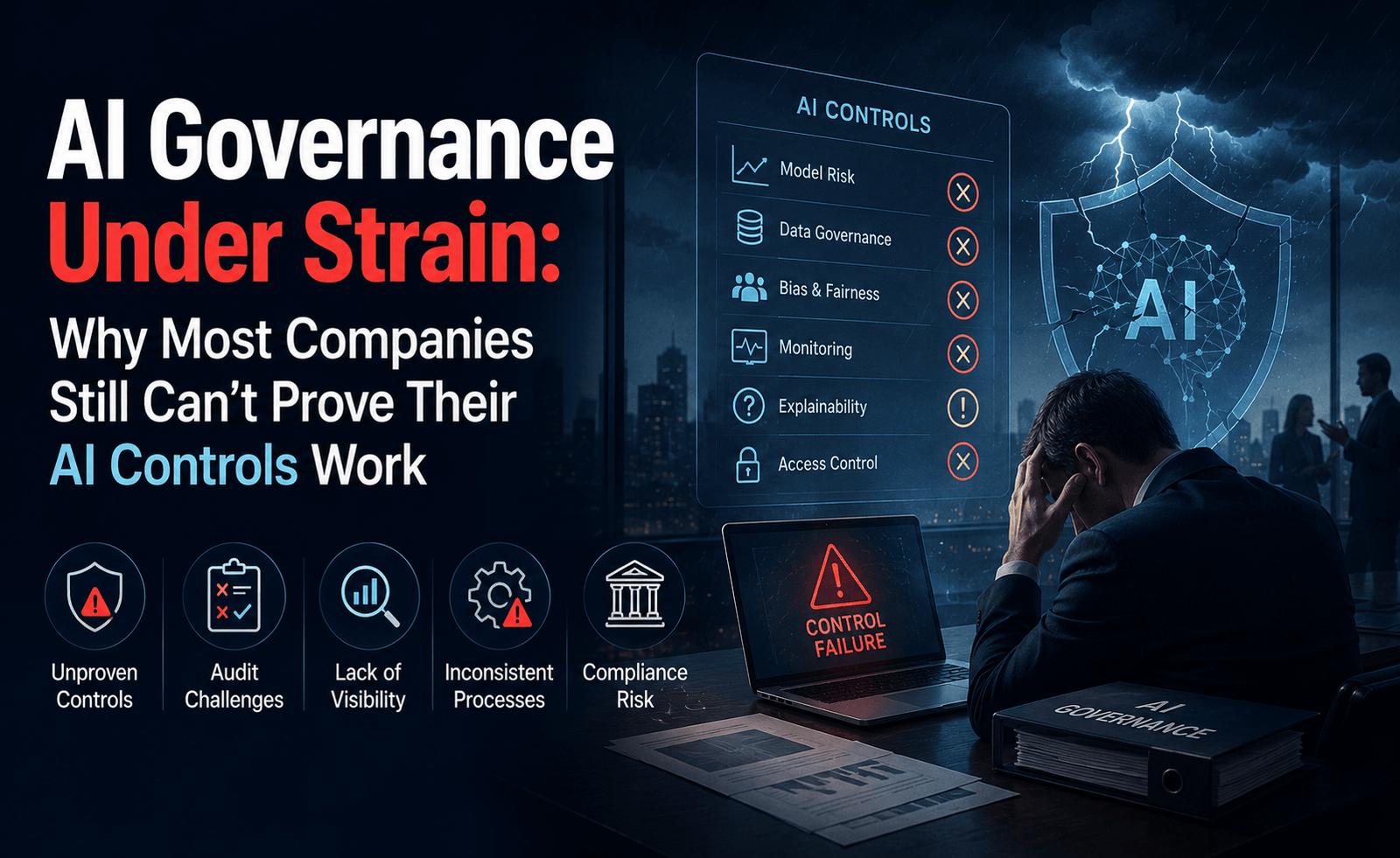
Two research releases this week, arriving from very different corners of the AI industry, tell a consistent and somewhat uncomfortable story: organizations are deploying AI faster than they are building the ability to prove that deployment is safe, effective, or even doing what it claims. Together, a new governance survey and a rigorous review of marketing claims about AI visibility offer a useful corrective to the industry’s default posture of confident forward motion.
The Governance Gap, By the Numbers
A newly published State of AI Governance report surveyed organizations already using AI in production and found a striking disconnect between perceived risk and actual oversight capability. Seventy-eight percent of respondents expect communications-related risk from AI to increase going forward — a clear signal that leadership is not naive about the potential for AI systems to generate misleading, inconsistent, or reputationally damaging output. Yet fewer than one in five of those same organizations say they can actually demonstrate, with evidence, that their governance controls are functioning as intended.
That gap between anticipated risk and demonstrable control is the report’s central finding, and it echoes a pattern seen repeatedly across enterprise technology adoption cycles: the speed at which a capability gets deployed consistently outpaces the speed at which an organization builds the audit trails, testing regimes, and accountability structures needed to manage it responsibly. What makes this cycle notably different is the sheer breadth of surface area AI touches — content generation, customer communications, decision support, and now autonomous agents acting on a company’s behalf — all at once, rather than one discrete system at a time.
The practical risk is not abstract. An organization that cannot demonstrate its AI governance controls are working is, by definition, also unable to reliably detect when those controls are failing. Problems surface reactively, through a customer complaint, a regulatory inquiry, or a viral social media post, rather than proactively through internal monitoring. For regulated industries in particular, that reactive posture is increasingly untenable as regulators in multiple jurisdictions move toward requiring documented evidence of AI oversight rather than accepting assurances at face value.
When the Data Contradicts the Marketing
The second release this week cuts closer to a specific and widely repeated industry claim. A comprehensive review of forty-five separate studies on so-called “generative engine optimization” — techniques marketed as improving how visible a brand’s content is within AI-generated search and chat responses — found no evidence that any evaluated technique consistently improves real-world discoverability, downstream website traffic, or measurable business outcomes across AI platforms.
Perhaps more striking than the negative finding itself is the review’s explanation for where the popular counter-narrative came from. A widely cited claim that these optimization techniques can boost visibility by roughly 40 percent traces back to a single laboratory metric that measured how prominently content was displayed after it had already been retrieved by an AI system — not whether optimization made that content any more likely to be retrieved in the first place. In other words, an entire cottage industry of consulting services and tooling appears to have been built, at least in part, on a statistic that measured the wrong stage of the pipeline.
The review’s authors call for more rigorous, standardized evaluation methods before further claims about this category of optimization are accepted at face value, noting substantial variability in how different AI platforms actually surface and rank third-party content. For marketing leaders who have allocated meaningful budget toward this discipline over the past year, the finding is a pointed reminder that a plausible-sounding statistic, repeated often enough across enough vendor pitches, can calcify into conventional wisdom well before anyone rigorously checks whether it holds up.
A Common Thread: Confidence Without Evidence
What links these two otherwise unrelated findings is a shared pattern: organizations, and the vendors serving them, are operating with a level of confidence that outstrips the evidence actually available to support it. In the governance case, that confidence takes the form of assuming existing oversight processes are adequate without the ability to test that assumption. In the optimization case, it takes the form of an entire market segment built around a metric that was never validated for the claim it was used to support.
Neither pattern is unique to AI. Every wave of enterprise technology adoption has produced some version of this gap between what organizations believe about their own capabilities and what they can actually demonstrate. But AI amplifies the stakes in two specific ways. First, the pace of deployment is faster than almost any prior technology cycle, leaving less natural time for governance practices to mature alongside capability. Second, AI systems increasingly generate customer-facing output and take autonomous action directly, which means governance failures surface externally — in front of customers, regulators, and the media — rather than remaining contained within internal systems.
Regulators Are Starting to Notice the Same Gap
The timing of this week’s governance findings is not coincidental to a broader regulatory trend that has been building throughout the year. Multiple jurisdictions have moved, or are actively moving, from voluntary AI principles toward requirements for documented evidence of oversight — audit logs, testing records, and demonstrable incident-response processes, rather than general policy statements about responsible AI use. A governance framework that exists only as a document, without the operational evidence to back it, is increasingly a compliance liability rather than a compliance asset in jurisdictions moving in this direction.
This shift changes the calculus for the fewer-than-one-in-five organizations that can currently prove their controls work. Under a voluntary framework, being unable to demonstrate governance effectiveness was primarily a reputational risk, surfacing only if something went publicly wrong. Under an evidence-based regulatory framework, it becomes a standing compliance gap that can be identified proactively during a routine audit, independent of whether any specific AI system has yet caused a visible problem. Organizations that treat this week’s survey findings as an early warning, rather than waiting for a formal regulatory requirement to force the issue, are likely to face a substantially lower cost of compliance than those that wait.
Building Governance That Can Actually Prove Itself
For organizations looking to close the gap this week’s research highlights, a few concrete steps stand out:
- Build an evidence trail, not just a policy document. A governance framework that cannot produce logs, test results, or audit records demonstrating it is functioning is not meaningfully different from having no framework at all when regulators, customers, or auditors come asking.
- Test AI-generated communications output on a recurring, sampled basis. Given that 78 percent of organizations already expect communications risk to rise, waiting for an incident to reveal a gap in oversight is a needlessly expensive way to discover a governance failure.
- Demand independent evidence for vendor performance claims. The optimization-industry finding is a cautionary tale specifically about accepting a headline statistic without tracing it back to what was actually measured. Any vendor claim about AI performance, visibility, or ROI deserves the same scrutiny before it shapes a budget decision.
- Treat agent sprawl as a governance risk category of its own. As more departments deploy their own AI agents, the number of discrete systems that need evidence-backed oversight grows accordingly. Governance frameworks built for a handful of centrally managed AI tools will not scale to an organization running dozens of semi-autonomous agents.
- Separate risk awareness from risk management. Recognizing that AI risk is rising, as most surveyed organizations already do, is not the same as having the capability to manage it. Closing that specific gap should be treated as its own budget line, not assumed to follow automatically from general AI investment.
The Bigger Picture
Neither of this week’s findings suggests organizations should slow their AI adoption. Both suggest, instead, that the governance and evidentiary infrastructure surrounding that adoption has not kept pace with the technology itself, and that this gap is now large enough to show up clearly in rigorous survey data and independent academic review. As AI systems take on more customer-facing and decision-making responsibility, the organizations that invest early in demonstrable, evidence-backed oversight are likely to be the ones that avoid the costliest surprises — and the ones best positioned to make genuinely informed decisions about which AI investments, from governance tooling to optimization services, are actually delivering what they promise.
There is a broader lesson here for how organizations evaluate any claim about AI performance, whether it concerns governance readiness, content visibility, or raw model capability. The instinct to trust a confident, widely repeated statistic is understandable given how quickly the AI landscape moves and how little time most teams have to independently verify every claim shaping their strategy. But this week’s findings suggest that instinct needs to be tempered with a standing habit of asking a simple follow-up question: what, precisely, was measured, and does that measurement actually support the conclusion being drawn from it? In an industry moving this quickly, that single question is likely to save more budget, and prevent more governance failures, than almost any specific tool or framework an organization could purchase.



Leave a Reply