

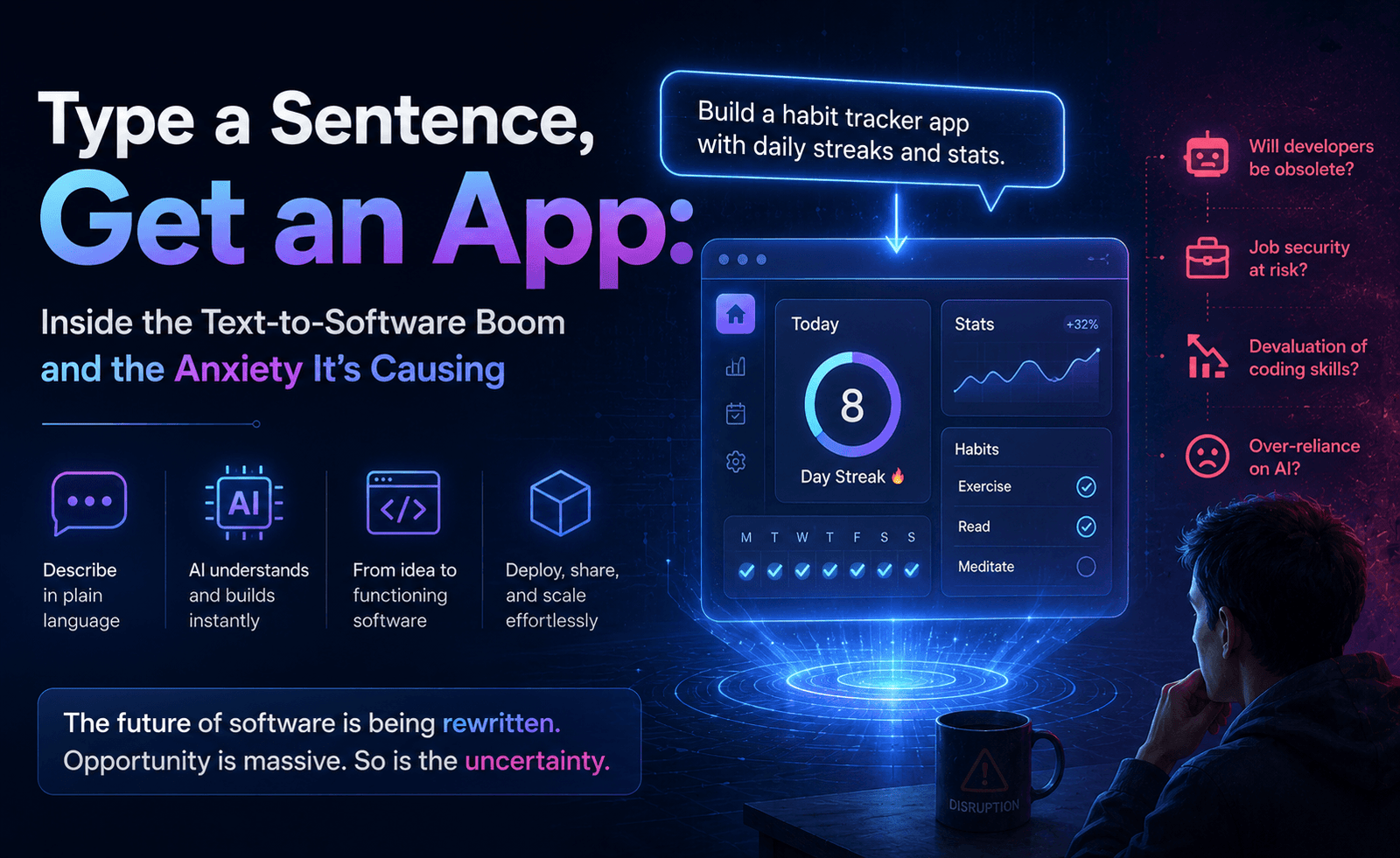
The gap between having an idea and having working software has never been thinner than it is right now, and this month’s launch of a new mobile feature from Roblox illustrates just how far that compression has progressed. The feature, called Build, lets anyone type a simple text description and receive a functioning, playable game in return, complete with gameplay mechanics, environment design, characters, visual style, and sound, all generated automatically and then available for the user to tweak and share. It is a striking demonstration of where text-to-software generation has arrived in 2026, and it is landing amid genuine, well-documented anxiety within the professional developer community about what that progress means for their livelihoods.
How Build Actually Works
The mechanics are deceptively simple from a user’s perspective. A person types a prompt describing the kind of game they want, something like a cozy adventure game set in a dense forest, and the tool generates an initial working version covering every major component of that description: core gameplay mechanics, the game’s environment and layout, character designs, an overall visual style, and accompanying sound design. Rather than producing merely a mockup or a static concept, the output is immediately playable, and users can continue refining and customizing the generated result before sharing it with others on the platform. The system runs on a combination of open-source and proprietary Roblox-developed models, and it joins a small but growing set of comparable AI game-generation tools that have already emerged from Google and Microsoft over the preceding months.
What makes this particular launch significant is not that AI-assisted game creation is new in concept; simplified game-creation tools with template libraries and drag-and-drop editors have existed for years. What is new is the compression of the entire creative and technical pipeline, concept, mechanics, art, audio, and a playable build, into a single natural language prompt with no intermediate steps requiring any technical skill whatsoever. That represents a meaningfully lower floor for what counts as “making a game” than any previous generation of creation tools has offered.
A Broader Pattern Beyond Gaming
Roblox’s Build feature sits within a considerably broader trend that extends well past game creation specifically. Text-to-software generation tools, capable of turning a natural language description into working code, a functioning app, or in this case a complete playable game, have proliferated rapidly across the software industry over the past year, driven by the same underlying advances in large language model reasoning and code generation capability that have made no-code AI agent platforms viable for enterprise workflows. The common thread across all of these tools is a fundamental shift in what determines whether software gets built at all: increasingly, the binding constraint is not technical skill or engineering capacity, but simply the ability to clearly articulate what you want.
That shift carries implications for professional software development that go well beyond any single product category. If a meaningful share of the software that previously required a trained developer, whether a simple mobile game, an internal business tool, or a basic customer-facing app, can now be generated directly from a plain-language description with acceptable quality, the traditional value proposition of entry-level and mid-level development work is facing a genuine structural challenge, not merely a productivity boost that makes existing developers more efficient at the same volume of work.
The Developer Community’s Documented Anxiety
That structural challenge is not merely a theoretical concern raised by outside commentators; it is showing up directly in survey data from within the game development profession itself. This year’s Game Developer Conference State of the Game Industry survey found that a majority of industry professionals, 52 percent, believe generative AI is having a negative overall impact on the field, a sentiment driven largely by concern that lowering the barrier to entry for game creation will flood platforms with a large volume of low-effort, AI-generated content, diluting both the discoverability and perceived value of professionally developed games in an already crowded marketplace.
That concern is not without historical precedent. Similar anxieties accompanied the earlier rise of accessible game-development engines and asset marketplaces, which did meaningfully lower the barrier to entry for game creation and did, by most accounts, increase the volume of lower-quality shovelware released onto major platforms. What is different this time is the scale and speed of the shift: previous democratization waves still required users to learn a development environment, however simplified, while text-to-game tools like Build remove even that minimal remaining skill requirement, compressing years of technical learning curve into the time it takes to type a single sentence.
Weighing the Democratization Argument Against the Quality Concern
Proponents of these tools make a reasonable counterargument: democratizing creative tools has historically expanded the overall pool of creative output and occasionally surfaced genuinely novel work from creators who would never have had access to the technical skills required under a higher barrier to entry, even as it also increases the volume of lower-quality content that platforms and audiences must sort through. Photography, music production, and video editing have all followed a broadly similar trajectory as accessible tools lowered technical barriers, and while each of those fields did see legitimate concerns about market saturation and professional displacement, none were wholly destroyed by the shift; instead, the professional tier of each field adapted around new tools while a much larger amateur and hobbyist tier expanded around them.
Whether game development, and software development more broadly, follows that same adaptation pattern rather than a more disruptive one remains a genuinely open question, and it is reasonable for the professional developer community to treat their documented concern as a legitimate signal rather than simple resistance to inevitable technological progress. The specific dynamics of software distribution platforms, where discoverability is often algorithmically mediated and a flood of low-effort content can meaningfully crowd out higher-quality work in ways that are harder to counteract than in more curation-heavy creative fields, may make this transition genuinely more disruptive than the historical parallels suggest.
What Platforms Are Doing About Content Quality
Platforms deploying these generation tools are not entirely blind to the quality and discoverability concerns their own products are likely to accelerate. Expect continued investment in more sophisticated content moderation and discovery algorithms specifically designed to surface higher-quality content regardless of whether it was created by a human, an AI tool, or some combination of both, alongside growing experimentation with labeling or disclosure requirements that distinguish AI-generated content from traditionally developed work, giving users and reviewers additional context when evaluating what they encounter. How effectively platforms execute on these mitigations will likely determine whether the developer community’s current anxiety proves prescient or overstated.
What to Watch Next
Several signals will help clarify how this trend develops over the coming year:
- Platform-level content volume and quality metrics following Build’s launch. A measurable increase in low-effort content relative to human-authored games would validate the developer community’s core concern.
- Whether competing platforms accelerate similar text-to-game feature launches. Broader adoption across Google, Microsoft, and other major platforms would confirm this as an industry-wide strategic direction rather than a single company’s experiment.
- Discoverability and algorithm changes on affected platforms. Watch for how quickly and effectively platforms adapt their recommendation and moderation systems to manage an increased volume of AI-generated submissions.
- Professional developer sentiment in subsequent industry surveys. Whether next year’s State of the Game Industry survey shows sentiment stabilizing, worsening, or improving will offer a clearer read on whether the profession’s current anxiety reflects a temporary adjustment period or a more durable structural concern.
- Monetization and career pathways for professional developers adapting to these tools. Watch for whether experienced developers increasingly position themselves around curation, quality assurance, and creative direction atop AI-generated foundations, rather than purely manual implementation work, as a viable adaptation strategy.
The Bigger Picture
Roblox’s Build feature is a genuinely impressive technical achievement and a clear signal of how far text-to-software generation has progressed this year, compressing what used to require substantial technical skill into a single natural language prompt. Whether that progress represents a net positive for the broader creative and professional ecosystem it is reshaping, as prior waves of creative tool democratization arguably were on balance, or a more disruptive shift that meaningfully displaces professional developers without a comparable adaptation path, is a question the industry is only beginning to grapple with in earnest. The documented anxiety among game developers themselves is a signal worth taking seriously, not dismissing as simple resistance to progress, even as the underlying technology continues to advance at a pace that shows no sign of slowing. What happens on gaming platforms over the coming year may well serve as a preview for how other creative and technical fields experience the same underlying shift, since the compression from idea to working software that Build demonstrates is not fundamentally specific to games, and is already extending into adjacent categories of consumer and enterprise software with similar implications for the professionals who currently build them by hand. How the industry manages that transition over the next year or two will likely say a great deal about which parts of software creation remain durably valuable specialist work, and which parts were, in retrospect, simply waiting for the right tool to make them accessible to anyone with an idea worth typing out.


Leave a Reply