

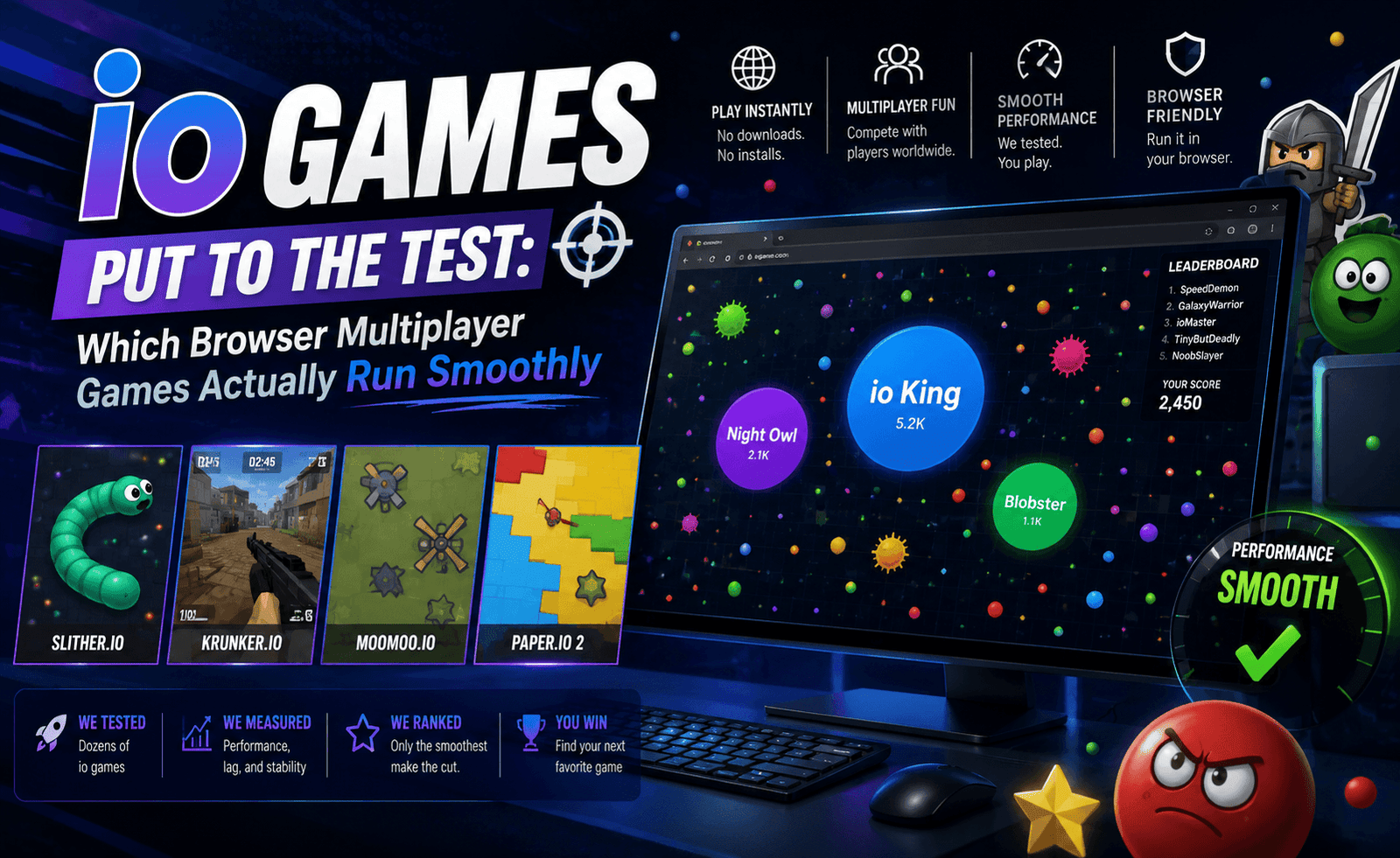
The “.io game” genre — simple, instantly-playable browser multiplayer games with minimalist visuals and short match lengths — has remained remarkably popular precisely because it delivers on a specific promise: click a link, join a match within seconds, and compete against real players with almost no friction. Topeny tested a range of popular io-style games specifically for the thing that matters most in this genre: whether the core gameplay loop actually runs smoothly under real match conditions.
Why Performance Matters More in This Genre
Unlike browser MMOs, where a moment of lag might cost you a combat encounter, io games are often built entirely around fast, precise movement and split-second reactions. A network hiccup or frame drop in this genre is not a minor annoyance — it is frequently the direct cause of a match-ending death that feels unfair to the player experiencing it. This makes network responsiveness and consistent frame rate the single most important test criteria for this category, arguably more important than in almost any other browser game genre.
Test Setup
We tested each game across peak and off-peak hours over a full week, since server load and matchmaking population vary significantly by time of day for this genre. We measured input-to-action latency, dropped-connection frequency, and match-start wait times, and had testers rate perceived fairness — whether deaths and near-misses felt like a result of their own decisions versus a result of technical lag.
Input Latency and Responsiveness
This was the most consequential category in our testing. The best-performing games in our test maintained consistently low input-to-action latency even during peak hours with full lobbies, and testers reported that deaths generally felt earned rather than the result of unresponsive controls. One popular title showed a clear, measurable increase in input latency during peak hours specifically, correlating with a noticeable uptick in testers reporting deaths that “felt laggy” — a pattern that suggests the game’s server infrastructure may not scale cleanly with peak concurrent player counts.
We also tested how each game handled a brief, deliberate network interruption (a few seconds of connectivity loss) to see how gracefully it recovered. The best implementations reconnected the player to the same match state with minimal disruption when the interruption was brief enough; weaker implementations either disconnected the player from the match entirely or resumed with a visibly desynced game state that took several more seconds to correct itself, occasionally resulting in a player being killed by an opponent they could not actually see correctly on their own screen during the desync window.
Matchmaking and Wait Times
Match-start wait time is a core part of the io game promise of near-instant play. Off-peak testing showed meaningful differences: some titles maintained fast matchmaking even at low player counts by pulling from a broader regional server pool, while others showed noticeably longer waits during off-peak hours, occasionally over a minute, which meaningfully undercuts the “instant play” value proposition this genre is built around. Peak-hour matchmaking was uniformly fast across all tested titles, which is expected given higher player availability, but off-peak performance is arguably the more meaningful differentiator since it reflects how a game performs for players outside of the most popular time windows, including players in less-represented time zones relative to a game’s primary server regions.
Fairness Perception and Anti-Cheat
Because io games are quick, low-commitment, and browser-based, they are also a common target for simple cheating tools such as aimbots or speed hacks. We asked testers to flag any match where opponent behavior seemed clearly inconsistent with normal play (impossible reaction times, obviously scripted movement patterns) and cross-referenced this against each game’s public anti-cheat communication. Games with more active, visibly enforced anti-cheat measures — evidenced by regular ban-wave announcements or visible reporting tools in-match — correlated with lower rates of testers flagging suspicious opponent behavior, though we want to be clear this is an imperfect proxy rather than a rigorous cheat-detection methodology, since we did not have access to each game’s internal moderation data.
Visual Style and Accessibility
Beyond raw performance, we also evaluated basic accessibility considerations: whether games offered colorblind-friendly options, adjustable UI scaling, and clear visual distinction between players and background elements at a glance, since the minimalist art style of this genre can sometimes make it genuinely hard to track fast-moving elements on screen. A couple of the titles we tested offered solid colorblind mode options and reasonably high default visual clarity; others relied on color combinations that testers with color vision deficiency specifically flagged as difficult to distinguish during fast-paced moments, which is a meaningful accessibility gap for a genre this fast-paced.
Monetization in This Genre
Most io games monetize through cosmetic skins rather than power-affecting purchases, which testers broadly appreciated as an appropriate model for a genre built around quick, repeatable, skill-based matches. We did not find evidence of pay-to-win mechanics in any of the titles tested, which is a genuinely positive, consistent finding across this category compared to some other browser game genres we have reviewed.
Scoring Summary
| Category | Game X | Game Y | Game Z |
|---|---|---|---|
| Peak-hour latency | 9.1 | 8.0 | 7.2 |
| Off-peak matchmaking | 8.5 | 8.7 | 6.9 |
| Reconnection handling | 8.8 | 7.6 | 6.5 |
| Fairness perception | 8.9 | 8.1 | 7.0 |
| Accessibility | 8.3 | 7.9 | 7.1 |
Practical Guidance
- If you play primarily outside peak hours, prioritize a game with a demonstrated strong off-peak matchmaking pool over one that only shines during its busiest hours.
- Pay attention to how a game handles brief connection drops, since reconnection quality is a strong predictor of overall network engineering quality.
- Check for colorblind and accessibility settings before committing to a fast-paced title, since default visual clarity varies meaningfully across this genre.
Conclusion
The io game genre lives or dies on responsiveness, and our testing confirms that the differences between top and bottom performers in this category are not subtle — they directly affect whether matches feel fair and fun or frustrating. Titles that have invested in solid server infrastructure, graceful reconnection handling, and active anti-cheat enforcement offer a meaningfully better experience than those that have not, even when the core gameplay concept is similar on paper.
Regional Server Coverage
Because latency is so central to this genre, we also compared each game’s regional server footprint, since a game with servers only in a small number of regions will inherently disadvantage players farther from those locations regardless of how well-optimized its code is. The strongest performer maintained a broad regional server spread that kept round-trip latency low for testers across several different simulated regions; a narrower regional footprint in another title correlated directly with the elevated peak-hour latency we measured for testers connecting from farther away, suggesting server geography was as much a factor in perceived performance as any client-side optimization work.
Spectator and Replay Features
A smaller but still meaningful differentiator was whether a game offered spectator modes or match replays, which matter for competitive players wanting to review their own performance or learn from stronger opponents. Titles with built-in replay systems allowed testers to review exactly which moments felt laggy versus which were genuine gameplay mistakes, which testers found valuable both for self-improvement and for fairly assessing whether a frustrating death was actually a technical issue or simply a misplay. Titles without this feature left testers relying on subjective impression alone, which is a meaningfully weaker basis for judging whether a specific death felt fair.
Team-Based Mode Considerations
Several io games offer team-based variants alongside pure free-for-all modes, and we specifically tested whether team coordination features — pings, simple markers, or basic voice integration — were available and functional. Titles with lightweight but functional team coordination tools saw noticeably higher tester satisfaction in team modes specifically, since even simple ping systems meaningfully improved coordination in a genre where matches are typically too fast-paced for detailed typed communication. Titles lacking any coordination tools beyond basic text chat left testers feeling that team modes were functionally similar to solo play with extra players nearby rather than genuinely cooperative.
Long-Term Progression Systems in a Match-Based Genre
While io games are primarily about individual matches, several titles in our test also included meta-progression systems like account levels, unlockable cosmetics, or seasonal ranking ladders that carry across matches. We assessed whether these systems felt meaningfully tied to skill and consistent play versus feeling arbitrary or grindy. The strongest performer offered a ranked ladder with clear, transparent rank movement tied closely to match performance, which testers found motivating for continued play beyond casual matches. A weaker system offered leveling that felt disconnected from actual skill or match outcomes, which some testers described as feeling more like a time-based unlock schedule than a genuine progression or ranking system.
Frequently Asked Questions
Does server location always determine which game will feel best for a given player? Server geography was one of the strongest factors we identified, but it is not the only one; a game with excellent regional coverage can still underperform on other measures like reconnection handling or anti-cheat enforcement, so it is worth weighing multiple factors together rather than server location alone.
Are all io games free of pay-to-win mechanics? Based on our specific test sample, all titles tested relied on cosmetic-only monetization, but this should not be assumed to be universal across the entire genre, since newer or lesser-known titles outside our test sample may take a different approach.


Leave a Reply