

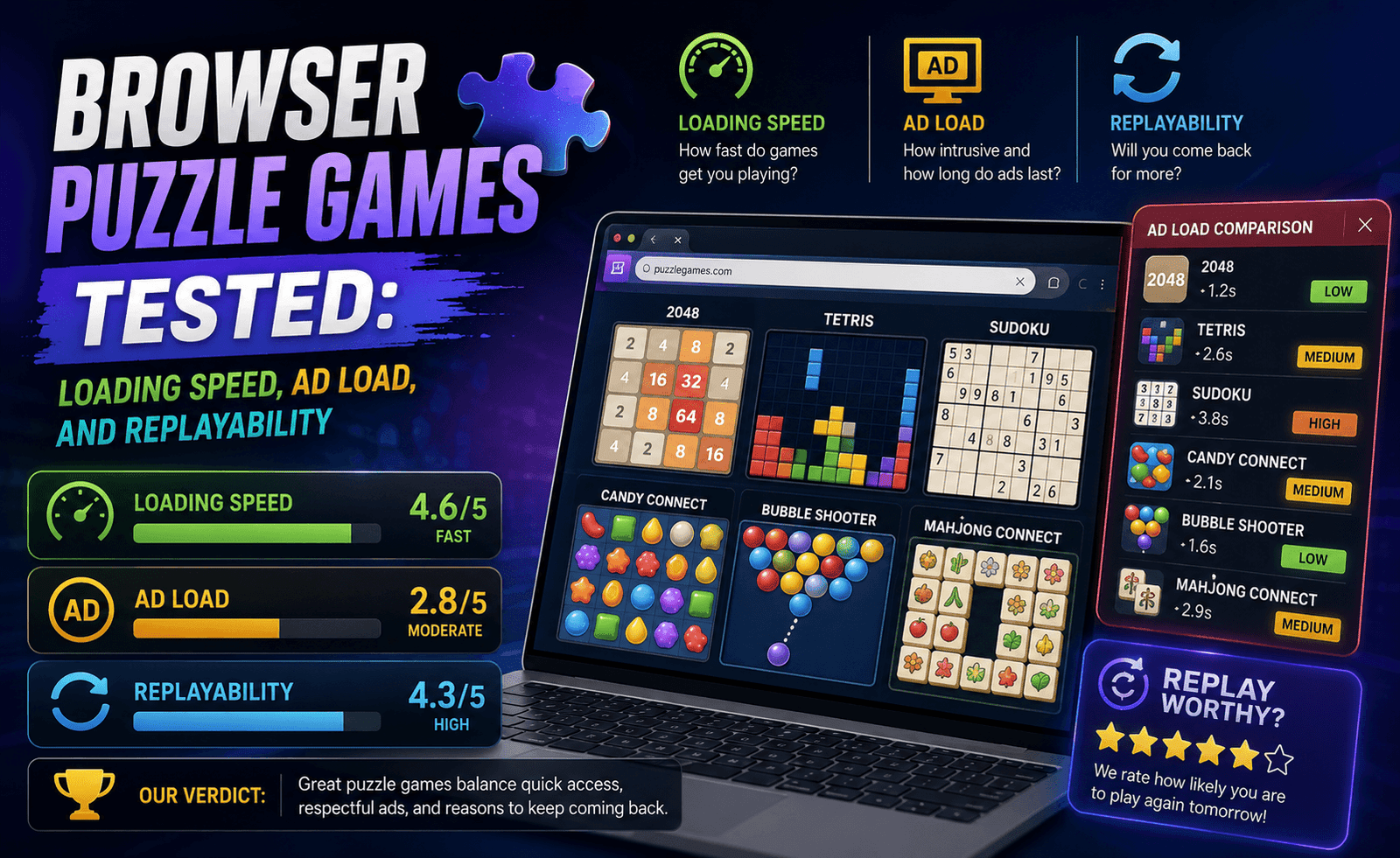
Browser puzzle games occupy a unique niche: they are often played in short bursts — a coffee break, a commute, a few idle minutes at a desk — which means the entire experience is judged on a much tighter tolerance for friction than a longer-session game genre. Topeny tested a selection of popular browser puzzle games specifically through this lens: how quickly can you start playing, how intrusive is the ad experience, and does the game actually hold up over repeated short sessions.
Why This Genre Demands a Different Test Lens
A puzzle game player opening a browser tab during a short break has a very low tolerance for delay or friction before actually playing. Unlike a browser MMO player who has budgeted an hour or more for the session, a puzzle game player who hits a slow load screen or an intrusive ad is far more likely to simply close the tab and never return. This makes load time and ad experience disproportionately important test criteria for this genre compared to others we have reviewed.
Load Time and Time-to-First-Puzzle
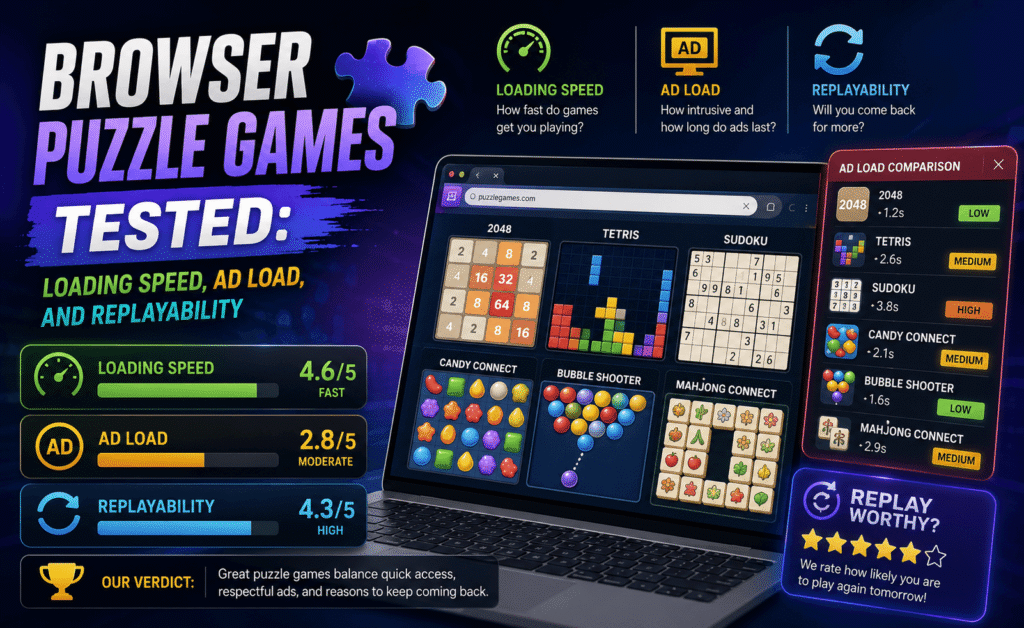
We measured not just raw page load time but the more meaningful metric of time from clicking the game link to actually being able to make a first move. Several games in our test achieved this in just a few seconds, loading a playable puzzle before non-essential assets like background music and cosmetic animations had even finished loading. One title, by contrast, required players to sit through a lengthy splash screen and an unskippable animated intro before the first puzzle became interactive, a design choice that testers consistently flagged as a poor fit for the genre’s short-session use case, regardless of how polished the intro animation itself was.
Ad Load and Placement
Nearly all browser puzzle games rely heavily on advertising for monetization, and how a game handles ad placement dramatically affects the perceived quality of the experience. We categorized ad experiences into three types: banner ads that do not interrupt gameplay, interstitial ads that appear between puzzles or levels, and rewarded video ads that are optional and tied to an in-game benefit. Games that relied primarily on optional rewarded ads scored highest with our testers, since players could choose to engage with an ad in exchange for a clear benefit (an extra hint, a retry) rather than having an ad forced upon them.
Games that used frequent, unskippable interstitial ads between nearly every level scored considerably lower, with testers specifically noting that the ad frequency in the weakest-performing title became actively disruptive to the puzzle-solving flow, appearing more often than felt proportionate to the length of gameplay between ads. We also checked ad-skip timing, since a supposedly skippable ad with an excessively long mandatory wait before the skip button appears functions, in practice, very similarly to an unskippable ad — a distinction some titles seemed to exploit more than others.
Difficulty Curve and Puzzle Design Quality
Beyond technical performance, we assessed the actual puzzle design quality across a representative sample of levels from early, mid, and late progression in each game. The best-designed titles introduced new mechanics gradually, gave players a genuine “aha” moment when a new mechanic clicked into place, and avoided levels that felt like padding — needlessly long or repetitive without introducing anything new. Weaker titles showed a pattern of difficulty spikes that felt disproportionate, or long stretches of levels that recombined existing mechanics without meaningfully building on them, which testers experienced as filler content designed primarily to extend playtime rather than to genuinely challenge or delight.
Progress Saving and Cross-Session Continuity
Because this genre is played in short, interrupted sessions, reliable progress saving matters enormously. We tested how consistently each game preserved progress across a closed browser tab, a cleared cache, and a switch between devices when an account system was offered. Games with account-based cloud saves handled all three scenarios reliably; games relying solely on local browser storage lost progress reliably when we cleared cache, which is a realistic scenario for many casual players who periodically clear browser data without realizing it will affect their game progress. This is a meaningful design gap that casual players may not discover until they have already lost significant progress.
Replayability
We assessed replayability by tracking whether testers voluntarily replayed completed levels for a better score or more efficient solution, and whether daily or rotating challenge modes gave players a reason to return beyond the core campaign. Titles with well-designed daily challenges and leaderboards showed noticeably higher voluntary return-play rates among our testers compared to titles with only a static level campaign and no ongoing content structure, confirming that a strong core puzzle design alone is not sufficient for long-term engagement without some structure encouraging repeat visits.
Scoring Summary
| Category | Game A | Game B | Game C |
|---|---|---|---|
| Time-to-first-puzzle | 9.2 | 8.5 | 6.4 |
| Ad experience | 8.7 | 7.0 | 5.8 |
| Puzzle design quality | 8.9 | 8.3 | 7.2 |
| Progress saving reliability | 9.0 | 7.5 | 6.8 |
| Replayability | 8.6 | 8.0 | 6.9 |
Recommendations
- Favor titles with account-based saving over local-storage-only saving if you plan to play across multiple devices or sessions.
- Watch for ad frequency during your first few sessions specifically; our testing found this to be one of the strongest predictors of whether testers continued playing past the first sitting.
- Look for daily challenge modes or leaderboards if you want a puzzle game with staying power beyond a single campaign playthrough.
Conclusion
Browser puzzle games are judged on a tighter margin for friction than almost any other genre we have tested, and the differences between titles in load time, ad experience, and progress-saving reliability turned out to matter as much to our testers’ overall enjoyment as the quality of the puzzles themselves. A well-designed puzzle campaign undermined by aggressive ad placement or unreliable saving left testers with a notably worse overall impression than a simpler but more frictionless and reliably-saved experience, a useful reminder that technical execution and respect for the player’s time are not secondary concerns in this genre — they are central to it.
Accessibility for Short Attention Spans
Because this genre is so frequently played during brief interruptions — a short break between tasks, a few minutes on public transit — we also evaluated how forgiving each game was of being interrupted mid-puzzle. The best-designed titles preserved exact puzzle state, including partial moves and undo history, when a player closed the tab and returned later, which meant an interrupted session did not feel like lost progress. Weaker titles reset the current puzzle attempt entirely if the tab was closed before completion, which testers found particularly frustrating given how central short, interruptible sessions are to how this genre is actually used in daily life.
Sound Design and Optional Audio
Sound design is easy to overlook in a text-based review but genuinely affects the felt quality of puzzle-solving, particularly the audio feedback for a correct move versus an incorrect one. Testers consistently rated titles with crisp, satisfying audio feedback more highly on subjective enjoyment even when the underlying puzzle mechanics were comparable to a competitor with flatter sound design. We also checked whether audio could be easily muted without affecting other settings, since puzzle games are frequently played in shared or quiet spaces where sound needs to be disabled quickly; all tested titles handled this basic requirement adequately.
Hint Systems and Difficulty Assistance
We also evaluated how each game handled players who got genuinely stuck, since a puzzle game with no path forward beyond pure trial and error risks losing players at exactly the moment their engagement is most fragile. The best-designed titles offered a tiered hint system, giving a small nudge before revealing a full solution, which testers appreciated for preserving a sense of accomplishment even when assistance was used. A weaker title offered only a binary full-solution reveal with no partial hint option, which testers felt undermined the satisfaction of eventually solving a difficult puzzle on their own once a hint had been used.
Cross-Device Continuity for Puzzle Games
We also checked how well progress carried over for players who might start a puzzle on a desktop browser and continue later on a phone, a realistic scenario given how frequently this genre is played across multiple devices throughout a day. Titles with account-based cloud saves handled this transition seamlessly in our testing, picking up exactly where a player left off regardless of device. Titles without account systems could not support this at all, effectively locking a player’s progress to whichever single device and browser they started on, which is a meaningful limitation for anyone who regularly switches between a work computer and a personal phone during the day.
Final Thoughts on This Genre
Browser puzzle games are often dismissed as a lightweight, low-stakes genre, but our extended testing suggests the technical and design execution gap between the best and weakest titles is just as real here as in more graphically demanding genres — it simply shows up in different places, namely load friction, ad experience, and save reliability rather than raw frame rate or visual fidelity.

Leave a Reply