

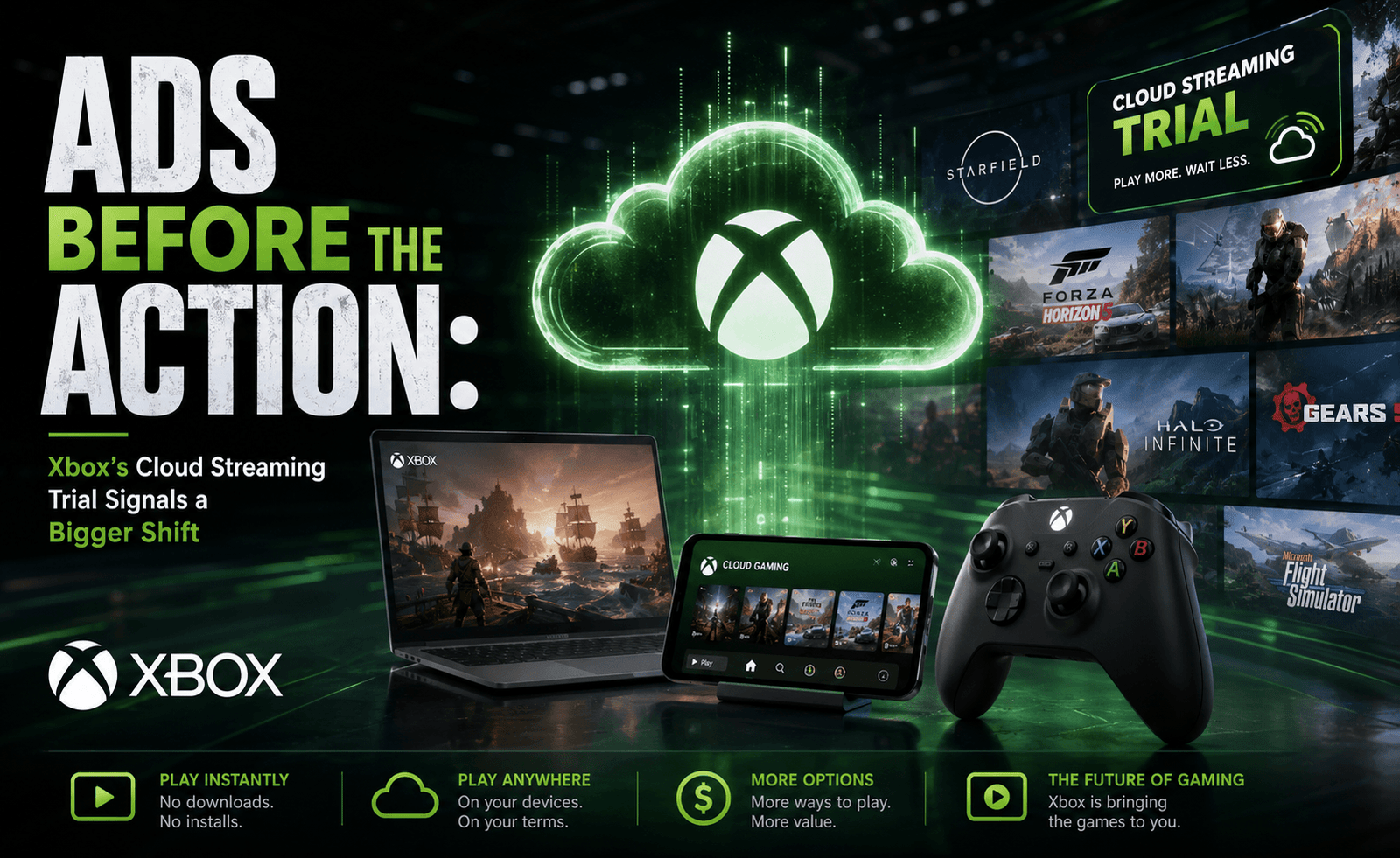
Microsoft opened a new front in gaming’s monetization wars this week, launching a limited test that lets Xbox Insiders stream games they already own through Xbox Cloud Gaming without paying for a Game Pass subscription, in exchange for watching a short advertisement before each session begins. The trial is modest in scope for now, but the framing Microsoft used to introduce it suggests a much broader ambition: a permanent, ad-supported layer sitting alongside traditional subscriptions across the entire Xbox ecosystem.
How the Test Actually Works
The mechanics are straightforward. Eligible Xbox Insiders with an Xbox account can now stream select games from their personal library, or free-to-play titles such as Call of Duty: Warzone, Genshin Impact, and War Thunder, without an active cloud gaming subscription. Before a session begins, users watch a pre-roll advertisement lasting up to roughly two minutes. Once the ad concludes, gameplay proceeds uninterrupted for up to one hour across supported devices and regions. If a player wants to continue beyond that hour, another round of ads plays before the next session starts.
Microsoft has been explicit that this is a test, not a committed product launch, and has not confirmed whether ad frequency, session limits, or the range of eligible titles will change during the trial period. More than 1,800 games in the Xbox Store currently support cloud streaming in some form, though the ad-supported test does not extend to that full catalog; access is currently limited to games a player already owns outright, plus a curated selection of free-to-play titles.
Why Now
The timing is not accidental. Cloud gaming has struggled for years with a fundamental adoption barrier: even players curious about streaming games rather than downloading or purchasing hardware have historically needed to commit to a subscription before they could try the experience at all. An ad-supported tier removes that friction entirely, letting a curious player test cloud streaming with zero upfront commitment, funded instead by advertisers eager to reach an audience actively engaged with interactive entertainment.
Microsoft has also framed the move partly as an accessibility play. The company noted that cloud streaming can let owners of older Xbox One hardware play newer titles built specifically for Xbox Series X and S without needing to purchase new hardware immediately, and suggested the ad-supported model could improve access to gaming in regions where consoles remain comparatively expensive or difficult to obtain. Whether that framing is primarily strategic communication or a genuine driver of the initiative, it does reflect a real structural advantage of cloud streaming: it decouples the ability to play current-generation games from the need to own current-generation hardware.
Not Microsoft’s First Attempt at This Playbook
Advertising is far from new to gaming. Free-to-play titles have relied on ad monetization for over a decade, and in-game placements, from billboards in racing games to sponsored content in mobile titles, have a long commercial history. What is genuinely new here is applying that advertising model to the access layer of a premium subscription service itself, rather than to gameplay content within a specific title. Xbox’s messaging around the trial explicitly acknowledges this history, stating that advertising has existed in gaming for decades but has not always been built with the player’s actual experience in mind, and laying out a set of principles the company says will guide how it approaches ad-supported services going forward: ads should create value, should not interrupt the flow of gameplay itself, should be held to the same quality bar as Xbox’s own content, and should be clearly labeled as advertising.
Those principles matter because they represent a deliberate attempt to draw a line between what Microsoft is testing now and the more aggressive, gameplay-interrupting advertising models that have drawn player backlash in mobile and free-to-play gaming for years. Xbox’s own chief strategist recently drew criticism for comments suggesting a broader appetite for in-game advertising beyond this specific streaming trial, which has left some industry observers skeptical that the company’s stated restraint around not interrupting gameplay will hold as the ad-supported strategy expands.
The Competitive Backdrop
Microsoft is not moving into uncharted territory here; it is following, and in some ways playing catch-up with, a broader cloud gaming market that has already experimented extensively with free access tiers. NVIDIA’s GeForce NOW, for instance, has long offered a free usage tier with time limits as a way to attract new users without requiring an immediate subscription commitment, and multiple competing cloud platforms have tested variations on limited-time free access funded through advertising or freemium upgrade paths. Xbox’s ad-supported trial can reasonably be read as an acknowledgment that the subscription-only model for cloud gaming access has hit a ceiling, and that a lower-friction, ad-funded on-ramp is necessary to meaningfully grow the cloud gaming audience beyond players already committed to a Game Pass subscription.
Two Audiences, Two Very Different Reactions
Reaction to the trial has split fairly predictably along the line between advertisers and players. Brand marketers have shown considerable interest in the format, for reasons that map closely onto why in-game advertising has been a growth category for years: gaming audiences skew younger, spend extended periods of sustained attention within a single session, and are otherwise difficult to reach through traditional broadcast or social advertising channels that increasingly struggle with ad-blocking and fragmented attention. A guaranteed, undivided viewing window before a play session begins is, from a media-buying perspective, a genuinely attractive and comparatively scarce advertising inventory type.
Player sentiment has been more mixed, and largely shaped by memories of how ad-supported models have played out in other corners of the gaming industry. Mobile free-to-play games, in particular, have a well-earned reputation for aggressive, sometimes exploitative advertising practices, including rewarded-ad loops explicitly designed to maximize watch time rather than serve player interest. Against that backdrop, some players have expressed skepticism that Microsoft’s current, comparatively restrained implementation, a single pre-roll ad with no in-session interruption, will remain the ceiling of the company’s ambitions rather than an opening move. That skepticism is not baseless; ad-supported tiers across media industries, from streaming video to music, have a consistent historical pattern of starting narrow and expanding over time as the underlying advertising business proves out.
Microsoft’s challenge, then, is less about whether the current trial design is reasonable in isolation, and more about whether it can convince a skeptical player base that this specific implementation represents a genuine, durable commitment to keeping ads out of active gameplay, rather than simply the first, most palatable step in a longer monetization roadmap.
What This Signals for the Subscription Model
The introduction of an ad-supported access tier alongside Xbox’s existing Game Pass subscription tiers raises an inevitable question: does this represent a genuinely new, complementary access point, or is it an early signal that Microsoft views advertising as a lever to eventually reduce reliance on subscription revenue growth, which across the industry has shown signs of plateauing after several years of rapid expansion? Microsoft’s own public statements lean toward the former framing, describing the ad-supported option as voluntary and explicitly preserving existing subscription paths for players who prefer them. But the broader industry pattern, in which ad-supported tiers frequently begin as a modest complement to subscription revenue and gradually expand in scope and prominence, gives reason for measured skepticism about how contained this experiment will remain over the following year.
What to Watch Next
Several developments will clarify whether this trial represents a minor experiment or the beginning of a structural shift in how Xbox monetizes cloud gaming access:
- Whether the test expands beyond the current Xbox Insider population. A broader public rollout would be the clearest signal that Microsoft considers the format validated and ready to scale.
- Any changes to ad frequency, length, or session limits during the trial. Microsoft has been careful about session caps and ad placement so far; loosening those constraints over time would suggest a shift toward more aggressive monetization.
- Expansion of the eligible game catalog. Currently limited to owned titles and select free-to-play games, a broader catalog would indicate Microsoft sees strong enough advertiser demand to justify wider content licensing for the ad-supported tier.
- Whether ads eventually appear within gameplay itself, not just before sessions. Microsoft’s stated principles currently draw a firm line against interrupting gameplay, but that line will be worth revisiting as the broader ad-supported strategy across Xbox develops.
- Competitor responses. If Sony or other cloud gaming providers introduce comparable ad-supported access tiers in response, it would confirm this is becoming an industry-wide monetization pattern rather than a Microsoft-specific experiment.
The Bigger Picture
Whether or not this specific trial expands into a permanent tier, it is a clear signal that the era of subscription-only access to premium cloud gaming is ending. As platform holders across the industry look for new ways to grow their audience and revenue beyond a subscriber base that has shown signs of saturating, ad-supported access points, carefully bounded for now but almost certainly destined to expand in scope, are likely to become a standard feature of the gaming landscape rather than a novel experiment confined to a single platform.

Leave a Reply