

Anyone who has spent significant time in competitive online lobbies, hosted their own multiplayer server, or built a public streaming presence around gaming has likely encountered, or at least heard of, the specific threat this report addresses: a rival player or disgruntled opponent using a paid “booter” or “stresser” service to knock a specific IP address offline in the middle of a match. It is one of the more frustrating and, unfortunately, common forms of harassment in online gaming, and it is also one of the clearest, most unambiguous use cases for a VPN’s protective capability. This report examines how DDoS attacks against gamers actually work, why a VPN is genuinely effective protection against them, and what limitations remain even with a VPN active.
How Gaming-Related DDoS Attacks Actually Work
A distributed denial-of-service attack works by overwhelming a target with more network traffic than its connection can handle, effectively knocking it offline until the flood of traffic subsides. In the context of online gaming, these attacks are almost always targeted at a specific individual’s IP address rather than at game servers themselves, since attacking a major publisher’s server infrastructure directly requires vastly more resources and typically triggers a much faster, more sophisticated defensive response than attacking a single home internet connection.
The mechanics of how an attacker obtains a target’s IP address vary by game and platform. Peer-to-peer connection models, common in many older or lower-budget multiplayer titles, directly expose player IP addresses to other participants in a match, making IP harvesting as simple as running basic network monitoring software during a game session. Even in games using dedicated server architectures that do not directly expose player IPs during matches, other channels, voice chat applications, direct messages containing malicious links designed to log an IP address, or even publicly available information tied to a gamertag, can provide the same result. Once an attacker has a target IP address, a wide range of commercially available, illegally operated booter services can be rented for a small fee to direct a flood of traffic at that address for a specified duration.
Why a VPN Is Genuinely Effective Protection
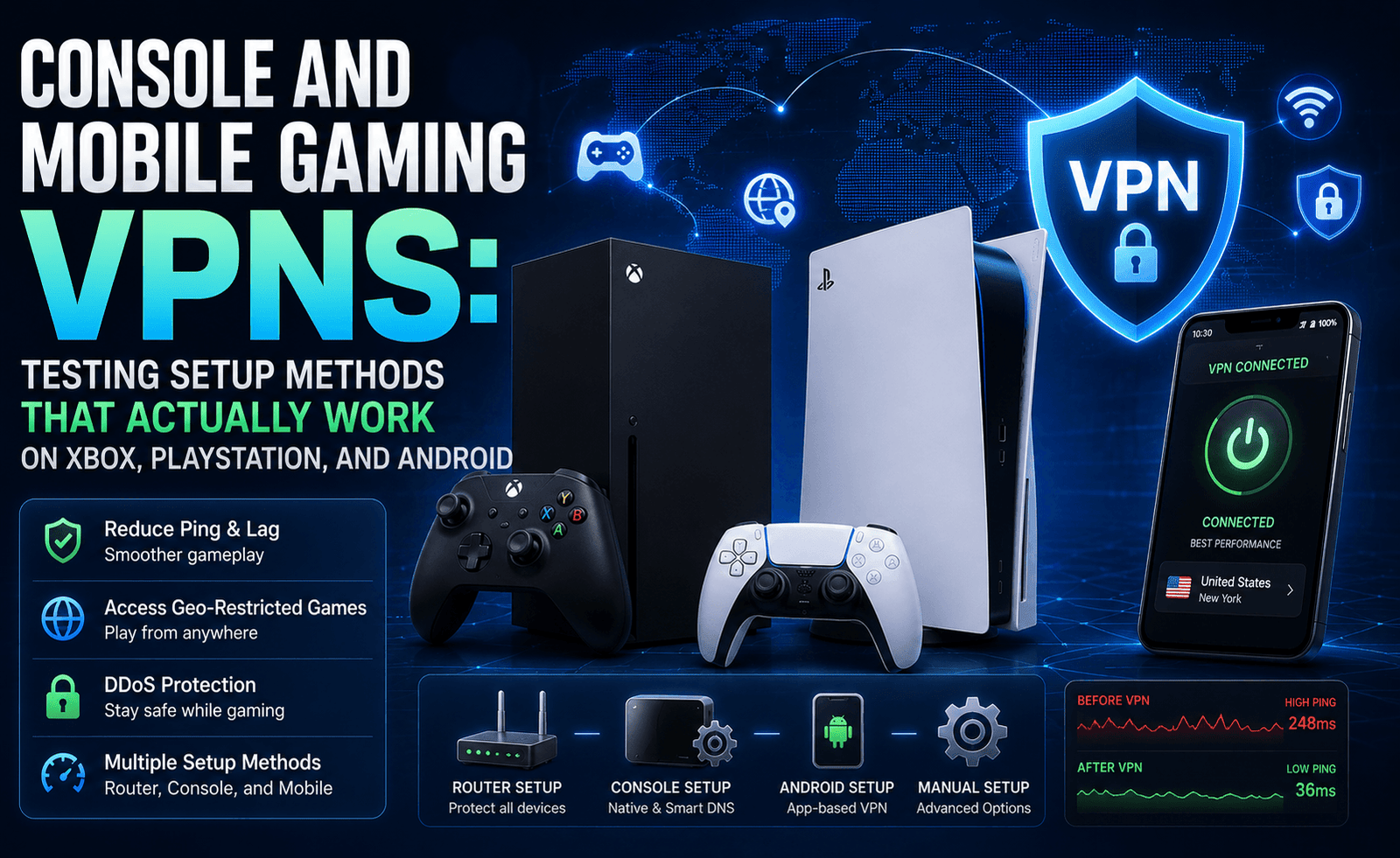
This is one of the clearer cases in the gaming VPN conversation where the protective claim holds up under real scrutiny rather than functioning as marketing exaggeration. When you connect to a game through a VPN, your traffic is routed through the VPN provider’s server infrastructure, meaning any other player, whether through peer-to-peer exposure or another IP-harvesting method, sees only the VPN server’s IP address rather than your actual home connection’s IP address. If an attacker then directs a DDoS attack at that visible IP address, the flood of traffic hits the VPN provider’s server infrastructure, not your home connection, and reputable VPN providers operate server infrastructure specifically built with substantial DDoS mitigation capacity designed to absorb exactly this kind of attack without meaningfully affecting service for any of their other users.
This is a fundamentally different scale of defense than what an individual home internet connection can offer on its own. Most residential internet connections have essentially no meaningful DDoS mitigation capacity; a moderately sized attack that a VPN provider’s infrastructure would absorb without a hiccup can completely knock a home connection offline for the duration of the attack. This asymmetry, between an attacker’s ability to rent modest but home-connection-crushing attack capacity cheaply, and a VPN provider’s substantially larger defensive infrastructure built to withstand exactly that kind of traffic at scale, is what makes VPN-based protection so effective for this specific threat.
What a VPN Cannot Protect Against
It is important to be precise about the limits of this protection, since overselling a VPN’s capability here does gamers a disservice. A VPN protects your actual home IP address from being targeted, but it does nothing to prevent an attacker from targeting the VPN server’s IP address itself, which, if successful at a scale the provider cannot absorb, would still disrupt your connection, just as a shared consequence of infrastructure-level congestion rather than a direct attack on your specific address. In practice, this scenario is rare against reputable large-scale providers precisely because their DDoS mitigation infrastructure is built to handle attack volumes far beyond what an individual booter service typically directs at a single target, but it is not a theoretical impossibility.
A VPN also does nothing to protect against IP exposure that happens before or outside of the VPN connection itself. If your IP address was harvested during a previous session before you started using a VPN, or through a channel unrelated to your gaming traffic entirely, such as a compromised account or a malicious link clicked outside the game, connecting to a VPN going forward will protect your current sessions but cannot retroactively un-expose information an attacker may have already obtained. Gamers who have previously been targeted should treat a VPN as one part of a broader response that may also include changing network configurations, contacting their ISP, or in persistent cases, requesting a new IP address assignment directly.
Server Selection Matters for DDoS Resilience Too
Not all VPN server infrastructure offers equivalent DDoS protection, and this is a meaningful differentiator worth checking before assuming any VPN provider offers adequate protection for this specific use case. Providers that operate their own physical server infrastructure, rather than leasing capacity from third-party data centers, generally have more direct control over network-level DDoS mitigation and can respond to attack patterns more quickly than providers relying on leased infrastructure with less direct operational control. Some providers explicitly advertise dedicated anti-DDoS infrastructure as a distinct feature on all or a subset of their server network, which is worth specifically confirming if DDoS protection is your primary reason for considering a gaming VPN, rather than assuming baseline DDoS resilience is uniform across every provider in the market.
The Legal Reality Behind This Threat
It is worth stating plainly that the threat this report addresses is not a gray-area gaming rivalry tactic but a serious criminal offense in most jurisdictions worldwide. Renting or operating a booter or stresser service to knock another individual’s internet connection offline constitutes a computer fraud and abuse offense under laws in the United States, the United Kingdom, and most other countries with developed cybercrime legislation, carrying penalties that can include substantial fines and, in more severe or repeated cases, imprisonment. Despite this, a persistent underground market of booter services continues to operate, often marketed deceptively as legitimate “stress testing” tools for network administrators, even though the overwhelming majority of their actual customer base and advertised use cases relate directly to gaming disputes and personal harassment rather than any legitimate network testing purpose.
Law enforcement agencies in several countries have conducted coordinated takedown operations against booter service operators and their infrastructure over the past several years, with mixed but gradually improving success, and some gaming platforms have begun cooperating more actively with these efforts by sharing abuse reports and connection metadata when formally requested through proper legal channels. That said, enforcement remains inconsistent and geographically uneven, which is precisely why individual protective measures like VPN usage remain the most reliable and immediately actionable defense available to the average gamer, rather than waiting for the underlying criminal ecosystem to be fully dismantled through enforcement alone.
Practical Steps Beyond Just Installing a VPN
For gamers specifically concerned about DDoS protection, a VPN is an important layer but works best combined with a few additional habits:
- Enable the VPN before launching any game with peer-to-peer connectivity. Protection only applies to traffic actually routed through the VPN tunnel; connecting after a match has already begun exposing your IP address defeats the purpose.
- Verify your VPN provider explicitly supports and permits gaming traffic. Some providers restrict or deprioritize peer-to-peer style traffic on certain server types, which can affect both performance and the completeness of your protection for specific game architectures.
- Consider a static or dedicated IP option if regularly hosting matches. Some VPN providers offer dedicated IP add-ons that provide the routing benefits of a private, consistent address while maintaining separation from your actual home IP, useful for gamers who frequently host servers or lobbies.
- Avoid clicking unfamiliar links from other players, even with a VPN active. IP-logging links represent an alternate exposure vector that VPN traffic routing alone does not address if you interact with a malicious link outside your protected gaming session.
- Report persistent harassment to platform moderators and, where appropriate, law enforcement. DDoS attacks against individuals are illegal in most jurisdictions, and a VPN reduces your exposure but does not substitute for reporting genuinely malicious, targeted harassment through appropriate channels.
The Bottom Line
Of all the claimed benefits attached to gaming VPNs, DDoS protection is among the most straightforwardly verifiable and least exaggerated. By masking your actual IP address behind infrastructure specifically built to absorb large-scale traffic floods, a reputable VPN provider offers a genuine, substantial upgrade in resilience compared to relying on your home connection’s essentially nonexistent native defenses. The protection is not absolute, and it works best as one component of a broader set of habits around IP exposure and online safety, but for anyone who games competitively, hosts multiplayer sessions, or streams under a public identity, it represents one of the more unambiguously worthwhile reasons to run a VPN during play.


Leave a Reply