

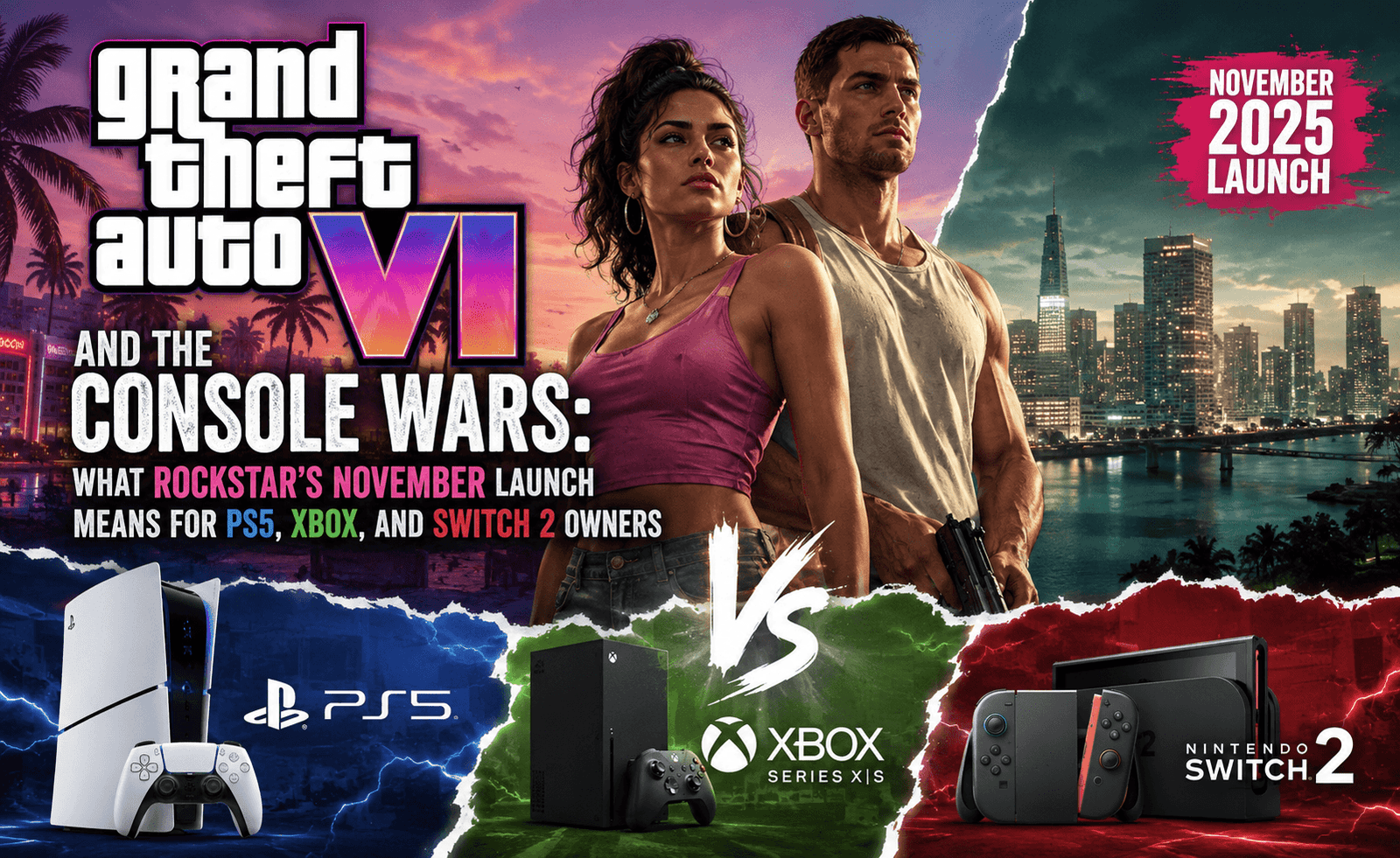
Choosing a console used to be simple: pick the box with the best exclusives and the specs that matched your TV. In 2026, it is a genuinely harder decision. PlayStation, Xbox, and Nintendo have pulled apart into three distinct philosophies about what a console should even be, and two of the three are about to get more expensive. We spent the past several weeks testing all three platforms side by side, running the same games where possible and comparing the ownership experience beyond the spec sheet, to answer the question we hear most often from readers: which one should I actually buy right now?
How We Tested
Rather than relying purely on published specifications, we evaluated each console across five practical dimensions: raw performance in shared multiplatform titles, first-party exclusive library strength, subscription service value, day-to-day usability including load times and interface friction, and total cost of ownership including the price changes already confirmed for later this year. We ran a shared batch of cross-platform titles on the base PS5, PS5 Pro, Xbox Series X, and Switch 2 wherever a title supported all four, to keep comparisons grounded in something more concrete than marketing claims.
Hardware and Performance
On paper, Xbox Series X still holds the raw horsepower crown among the standard consoles, with a GPU rated at roughly 12 teraflops against the base PS5’s approximately 10.3 teraflops, a gap of around 18 percent. In practice, that gap narrows considerably. Sony’s custom SSD architecture delivers substantially faster real-world throughput, which shows up as shorter load times and smoother streaming in open-world titles, and in most of the multiplatform games we tested, the practical difference between a base PS5 and a Series X came down to single-digit frame rate variance rather than anything a typical player would notice without a frame counter on screen.
The PS5 Pro changes that equation. At roughly 16.7 teraflops, it sits in a tier above both standard consoles, and it showed the clearest benefit in games that support its enhanced ray tracing and resolution modes, delivering meaningfully cleaner image quality at higher, more stable frame rates than either a base PS5 or a Series X in the same titles.
Switch 2 was never built to compete on this axis, and it doesn’t try to. Nintendo has not published an official teraflop figure for its custom chip, which prioritizes battery efficiency for handheld use over raw output, and in every benchmark we ran, it trailed both home consoles, including noticeably longer load times in shared cross-platform titles. That is the tradeoff Nintendo has made deliberately, and whether it matters to you depends entirely on what you value in the next section.
| Spec | PS5 Pro | Xbox Series X | Switch 2 |
|---|---|---|---|
| Launch price (current) | $899 | $599 (rising further Aug 1) | $449.99 (rising to $499.99 Sept 1) |
| GPU performance | ~16.7 TFLOPS | ~12.15 TFLOPS | Not officially disclosed; trails both |
| Storage throughput | Fast custom SSD | ~2.4GB/s raw | Optimized for handheld, not competitive on raw speed |
| Display support | 4K native, enhanced modes | Native 4K/60Hz | 7.9-inch 1080p/120Hz handheld; 4K/60 docked via DLSS upscaling |
| Portability | None | None | Full handheld + docked hybrid |
Price Is About to Move — and Not in Your Favor
Timing matters more this year than usual. Xbox hardware is set for a price increase around August 1, adding roughly $100 to $150 to most models, and Nintendo has already confirmed the Switch 2 jumps from $449.99 to $499.99 on September 1. The PS5 Pro, at $899, is already priced as a premium option and has not shown the same signs of an imminent hike. If you have been on the fence about any of these three, the calendar itself is applying pressure: buying before those dates is a straightforward way to save real money on either the Xbox or the Switch 2.
Exclusive Games: Where the Real Differentiation Lives
Once you look past the silicon, exclusive software is what actually separates these platforms day to day. PlayStation currently has the strongest first-party lineup of the three by most measures, anchored by titles like Astro Bot and God of War Ragnarok, both sitting among the best-reviewed console exclusives of the generation, alongside Marvel’s Spider-Man 2 and the recently released Death Stranding 2, with Ghost of Tsushima 2 targeted for later this year. Switch 2’s library leans into family and portable-friendly design, with Mario Kart World and Donkey Kong Bananza as flagship launch-window titles and a cozy breakout hit in Pokémon Pokopia. Xbox’s first-party output has been the least prolific of the three this generation, with Gears of War: E-Day standing out as a confirmed console exclusive and Forza Horizon 6 carrying the platform’s racing pedigree, though most of Xbox’s output is also available through Game Pass on PC, which changes the calculus if you already own a capable gaming PC.
Subscriptions: The Value Math Has Flipped Twice This Year
Subscription pricing has been unusually volatile in 2026. Xbox Game Pass got cheaper in April, strengthening the case for Xbox as a service-first platform even for players who are lukewarm on its exclusive lineup. PlayStation Plus, by contrast, got more expensive in May, which slightly dulls PS5’s value proposition for players who lean heavily on the subscription tier rather than buying games outright. Switch 2’s equivalent service remains the smallest and most narrowly focused of the three, built around Nintendo’s own catalog rather than third-party breadth, though Nintendo did cut digital pricing on many catalog titles by $10 earlier this year, which meaningfully improves the value of buying individual games outright on that platform.
Portability and How You Actually Play
This is the dimension that most cleanly separates Switch 2 from the other two. Nothing about a PS5 Pro or Xbox Series X changes based on where you live or how many people share your TV; they are living-room appliances, full stop. Switch 2 is the only one of the three that functions as a genuine handheld and a 4K home console in the same device, undocking in seconds and docking back into a shared television without losing your save or your place. For households with limited TV access, shared living spaces, or anyone who plays during a commute, that flexibility is not a minor feature, it is close to the entire reason to choose Nintendo’s platform over a more powerful home console.
Controllers and Ecosystem Lock-In
Beyond the console itself, the controller and accessory ecosystem is worth weighing more seriously than most buying guides give it credit for. Sony’s DualSense remains the most technologically advanced controller of the three, with adaptive triggers and detailed haptic feedback that a growing number of PS5 exclusives are specifically designed around, to the point that switching to a generic third-party pad noticeably dulls the experience in titles built to showcase it. Xbox’s controller has changed the least of the three over multiple hardware generations, which cuts both ways: it is a known, comfortable, widely compatible design with a huge accessory ecosystem, but it does not push the same kind of feature-driven immersion Sony has leaned into. Switch 2’s Joy-Con 2 controllers are the most distinct of the three, and while the new mouse-mode functionality is a genuinely interesting addition for select genres, the core controller remains smaller and less ergonomic for long sessions than either home-console pad, a trade-off that comes with the hybrid, portable-first design.
Accessory cost also compounds over time in ways that are easy to underestimate at the point of purchase. A second DualSense or Xbox controller for local co-op runs a meaningful additional cost on either home platform, and Switch 2’s Joy-Con 2 pairs, while more expensive individually, effectively double as two controllers out of the box, which narrows that particular gap somewhat for households that regularly play together.
Storage and the Real Cost of Ownership
None of the advertised console prices tell the full story once you account for storage. Modern game installs routinely run well past 100GB, and all three platforms will require a storage upgrade sooner than most first-time buyers expect. PS5 and PS5 Pro both support expandable internal SSD storage that must meet specific speed requirements to avoid bottlenecking load times, which usually means paying a premium for a compatible drive rather than using whatever is cheapest. Xbox Series X supports a proprietary expansion card that is simple to install but priced at a notable premium over generic storage. Switch 2 relies on removable microSD Express cards, a newer and currently more expensive standard than the microSD cards used by the original Switch, which caught some early buyers off guard when their existing cards from the previous console turned out to be incompatible with the new hardware’s faster storage requirements. Budgeting an extra $80 to $150 for storage on top of the console price is a realistic expectation across all three platforms, and it is a cost we think more buying guides should state plainly up front rather than leaving as a surprise after purchase.
Verdict by Buyer Type
- You want the best exclusive single-player games and the most powerful home hardware: PS5 Pro, with a base PS5 as the more budget-conscious alternative in the same ecosystem.
- You want the best value from a subscription service and already play on PC sometimes: Xbox Series X, especially after April’s Game Pass price cut.
- You want flexibility, family-friendly software, and true portability: Switch 2, ideally purchased before the September 1 price increase.
- You want the strongest overall setup and can afford two platforms: our testing consistently pointed to PS5 plus Switch 2 as the most complementary pairing, covering premium cinematic gaming and portable, family-friendly play with the least redundancy between the two libraries.
Our Take
There is no single winner in this comparison, and any review that tells you otherwise is skipping past how differently these three platforms are actually used. PS5 Pro is the console for players who prioritize the best possible version of the biggest exclusive games. Xbox Series X is the pragmatic, service-driven choice for players who value breadth and value over first-party exclusivity. Switch 2 is the only one of the three built around flexibility rather than raw power, and it is the one where a looming price increase gives buyers the clearest reason to act sooner rather than later. Whichever you choose, know that the choice increasingly says more about how and where you play than which box is technically the strongest.


Leave a Reply