

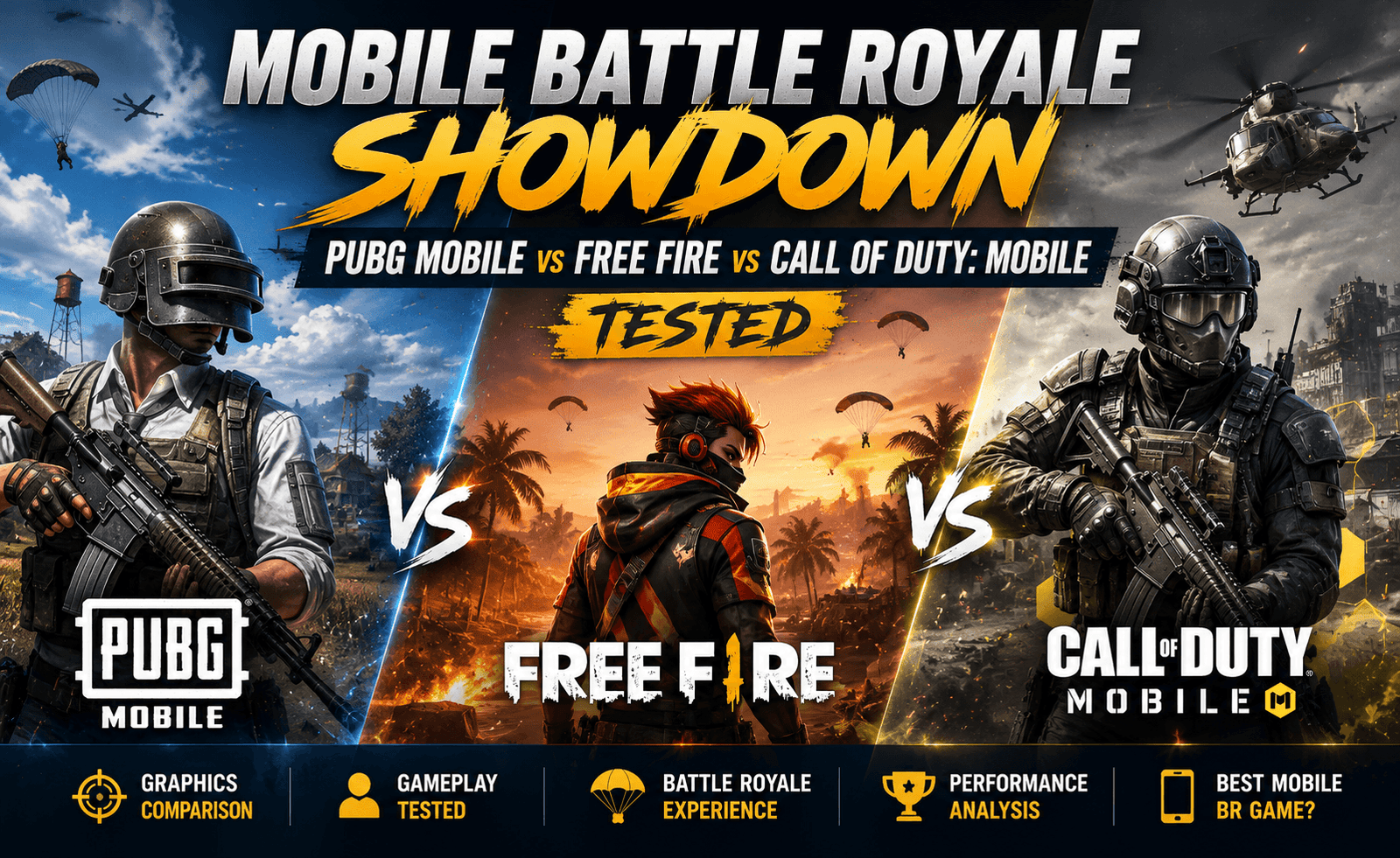
Mobile battle royale hasn’t consolidated around a single winner the way some genres have — instead, three very different games have each carved out a lasting audience by making fundamentally different design choices. We spent real time in PUBG Mobile, Free Fire, and Call of Duty: Mobile to see how they actually compare in 2026, not just on paper, but in the way each one feels to play, run, and spend money in.
The Core Design Philosophy Difference
Before getting into specifics, it’s worth understanding that these three games aren’t really competing for the exact same player. PUBG Mobile is a realistic, military-style battle royale built around tactical positioning, ballistics, and longer, more methodical matches with up to 100 players. Free Fire was designed from day one around accessibility — shorter 10-to-15-minute matches with around 50 players, simplified mechanics, and strong performance on entry-level hardware. Call of Duty: Mobile splits the difference in an interesting way, offering both a battle royale mode and traditional fast-paced multiplayer modes like Team Deathmatch and Domination, wrapped in visual fidelity that pushes noticeably harder on your hardware than either of the other two. It’s worth noting this isn’t a hierarchy of quality — each of the three has sustained a large, loyal, multi-year player base precisely because it commits fully to its own design philosophy rather than trying to be a slightly different version of a competitor.
PUBG Mobile: Tactical Depth at a Hardware Cost
PUBG Mobile runs on Unreal Engine 4, and the visual difference compared to Free Fire is obvious from the moment you load into a match — more detailed environments, more realistic weapon handling, and a slower, more deliberate pace that rewards positioning and patience over reflexes alone. Losing a fight in PUBG Mobile tends to feel like it was earned rather than random, which is exactly the appeal for players who want depth and a real skill ceiling. That realism comes with tradeoffs: matches run longer, there’s more downtime traveling across large maps, and it demands more from your device than Free Fire does. It also tends to attract a more committed spending audience — in our observation and in line with broader industry commentary, PUBG Mobile’s player base skews toward higher average spend than Free Fire’s, even though Free Fire’s total player count is larger in aggregate.
Free Fire: Built for Speed and Accessibility
Free Fire’s entire design is built around getting you into action fast and keeping matches short enough to fit into a genuine break in your day. Fifty players, a smaller map, fights starting almost immediately rather than after a long quiet approach phase, simplified recoil patterns, fewer weapon attachments to manage, and more generous auto-aim assistance all add up to a game that’s dramatically easier to pick up than PUBG Mobile, without being a lesser game — it’s a different one, built for a different kind of session. Free Fire’s especially strong performance in regions where budget Android devices are the norm — parts of South Asia, Southeast Asia, and Latin America — isn’t an accident; the game was engineered specifically to run well on hardware that would struggle with PUBG Mobile or Call of Duty: Mobile.
Call of Duty: Mobile: The Most Demanding of the Three
Call of Duty: Mobile delivers the closest thing to a console shooter experience currently available on a phone, and that fidelity is the whole point — but it asks a lot of your device in return. Expect a large and steadily growing install size as content updates accumulate, along with meaningfully higher minimum hardware requirements than either PUBG Mobile or Free Fire. If your phone is a few generations old or sits at the budget end of the market, this is the title in this comparison most likely to disappoint on performance, even at reduced graphics settings. For players with a capable mid-range or flagship device, though, the payoff is real: smoother animations, more detailed environments, and a broader mode selection that goes beyond battle royale alone.
Monetization Compared
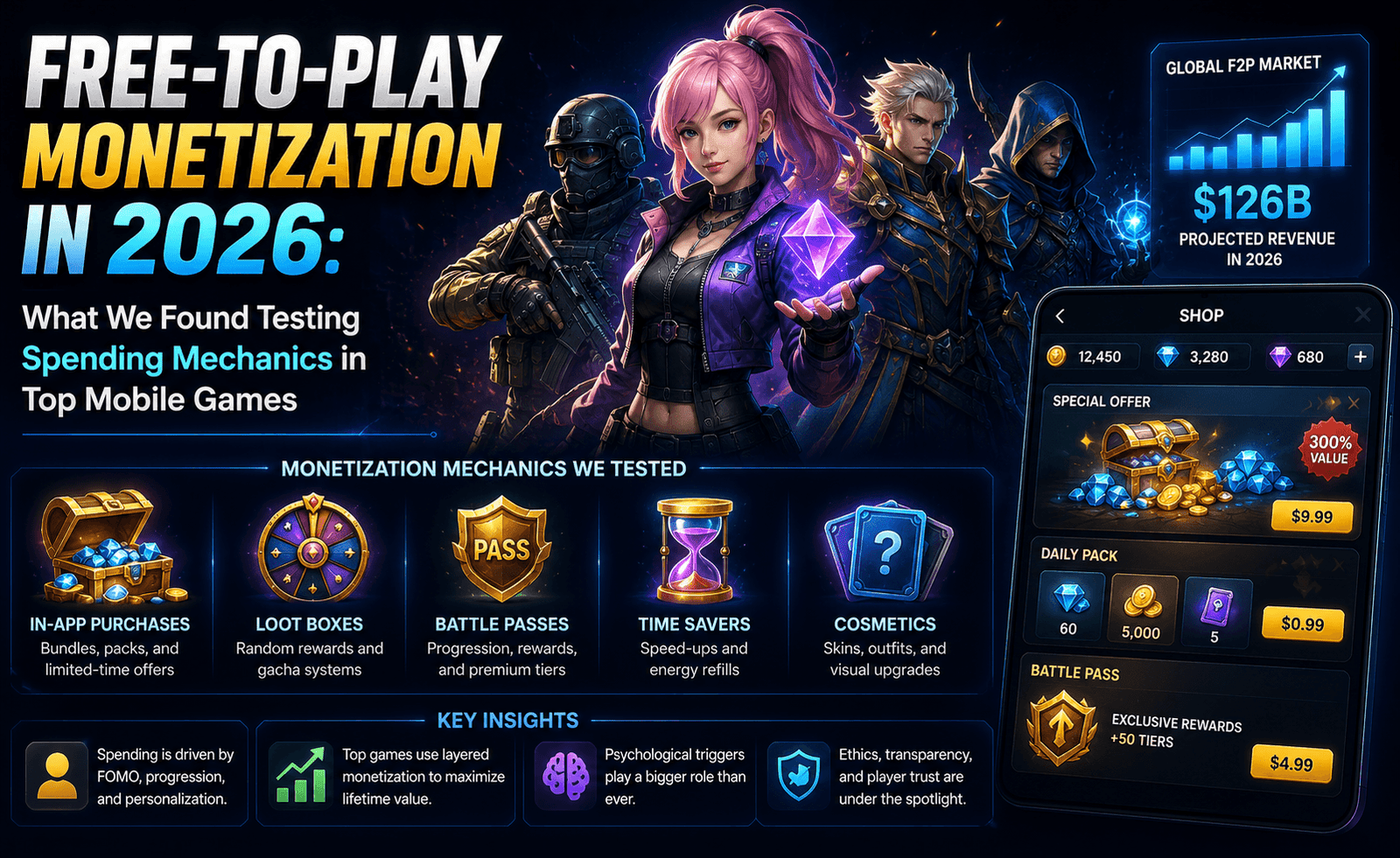
All three games are free-to-play with battle passes and cosmetic-focused monetization at their core, but the intensity differs. PUBG Mobile’s cosmetics and battle pass systems tend to skew toward a more dedicated, higher-spending audience, reflecting its more hardcore player base. Free Fire’s in-game economy is generally positioned as more affordable and accessible, matching its broader, more price-sensitive audience across emerging markets. Call of Duty: Mobile follows a fairly standard battle-pass-plus-cosmetics model similar to its console and PC counterparts. None of the three currently relies on pay-to-win mechanics that directly affect competitive balance in ranked play, though as with any live-service game, it’s worth periodically checking community sentiment and recent patch notes, since monetization balance in these titles shifts over time.
Comparison Table
| Game | Match Length | Player Count | Hardware Demand | Best For |
|---|---|---|---|---|
| PUBG Mobile | Long (20–30 min) | Up to 100 | Moderate–High | Tactical, methodical players who want depth |
| Free Fire | Short (10–15 min) | ~50 | Very Low | Quick sessions, budget devices |
| Call of Duty: Mobile | Varies by mode | Varies (BR + multiplayer modes) | High | Players wanting console-quality fidelity and variety |
Graphics, Controls, and Feel: A Closer Look
Beyond the headline design philosophy differences, a few specific details stood out during our hands-on sessions. PUBG Mobile’s gunplay includes realistic bullet drop and recoil patterns that genuinely reward practice in the training range before jumping into ranked matches — new players who skip this step tend to have a noticeably rougher first few hours than in either competitor. Free Fire’s character system layers in unique special abilities on top of standard battle royale mechanics, which adds a light strategic wrinkle around ability cooldowns and team composition that PUBG Mobile’s more purely tactical approach doesn’t include. Call of Duty: Mobile’s controls felt the most immediately familiar to anyone coming from console or PC Call of Duty titles, with weapon handling and movement that closely mirrors its bigger-budget siblings, though that familiarity is part of what makes its hardware demands harder to compromise on without a real feel difference.
Which One Should You Actually Download?
Start with your device and your available time, in that order. If your phone is a few years old or on the budget end, or if your play sessions are typically short and interrupted, Free Fire is the most forgiving choice by a wide margin. If you have a capable mid-range phone and want a battle royale experience with genuine tactical depth and a real skill ceiling, PUBG Mobile remains the strongest option in that category. If you have a recent flagship-class device, plenty of storage to spare, and want the broadest mode variety — traditional multiplayer alongside battle royale — Call of Duty: Mobile delivers the most console-like experience of the three, provided your hardware can keep up.
None of these choices is permanent or exclusive — all three are free to download, and trying each for a single evening will tell you more about which fits your play style than any comparison, including this one.
Frequently Asked Questions
Which of these three games is easiest for a complete beginner?
Free Fire, by a clear margin. Simplified recoil, fewer weapon attachments to learn, and more generous auto-aim make it the most approachable entry point into mobile battle royale, and its shorter matches mean a bad round costs you far less time than in PUBG Mobile.
Can I play any of these competitively, or are they mostly casual?
All three have active esports scenes, though PUBG Mobile and Call of Duty: Mobile tend to attract the more established competitive infrastructure, with dedicated ranked ladders, tournaments, and prize pools. Free Fire also maintains a real competitive scene, particularly strong in the regions where its casual player base is largest.
Do I need to spend money to be competitive in any of these games?
In our testing, none of the three currently sells direct gameplay advantages through paid purchases in ranked or competitive modes — spending is concentrated on cosmetics, battle passes, and convenience items rather than stat-boosting gear. Skill and practice remain the primary determinants of competitive success across all three, though this is worth periodically re-checking as live-service games evolve their monetization over time.
Which game has the smallest install size?
Free Fire is consistently the lightest of the three, in keeping with its low-end-hardware-first design philosophy. Call of Duty: Mobile is the largest by a significant margin once you account for accumulated content updates, so check your available storage before downloading it, particularly on a device with limited internal storage.
Bottom Line
PUBG Mobile, Free Fire, and Call of Duty: Mobile aren’t really rivals fighting over the same player — they’re three distinct answers to “what should mobile battle royale feel like,” and 2026’s mobile gaming scene is genuinely better for having all three actively supported and updated. Match your choice to your device and your available session length rather than chasing whichever one is loudest in your social feed this week, and you’ll likely end up happier with the result.

Leave a Reply