
Introduction
Every year, one AI video model manages to combine strong output quality with a price tag that undercuts the competition badly enough to change buying behavior across the industry. In 2026, that model is Kling 3.0. Built by Kuaishou, the company behind one of the largest short-video platforms in the world, Kling has spent the last two release cycles closing the quality gap with Google and OpenAI while keeping its per-second cost meaningfully lower than either. The Topeny Team put Kling 3.0 through the same 40-prompt test bank we use across this category to see whether the value reputation is deserved or overstated.
What Is Kling 3.0?
Kling 3.0 is Kuaishou’s flagship text-to-video and image-to-video model, available through the Kling web app, mobile app, and a developer API. It is positioned heavily around cinematic storytelling and multi-shot sequences, with Kuaishou’s own marketing leaning on professional filmmaking use cases rather than short social clips alone, a notable shift from where the product started. A free tier with daily generation limits remains available, which makes it one of the more accessible ways to start testing AI video without committing budget up front.
Our Testing Methodology
As with every report in this series, we ran Kling 3.0 through the Topeny Team’s standard 40-prompt suite spanning photorealistic human subjects, nature and environmental scenes, product shots, complex camera movement, dialogue and sound-dependent scenes, and multi-shot continuity tests. Each prompt was generated three times to check consistency, and two reviewers scored every output independently before we averaged the results. We tested through both the consumer web app and the developer API to see whether output quality differed between the two access points. It did not, meaningfully, which is a good sign for consistency.
Key Findings
Subject Consistency and Physical Motion
This is where Kling 3.0 separates itself from the field. Across our multi-shot continuity bucket, Kling held a character’s face, clothing, and proportions consistent from shot to shot more reliably than any other model we tested this cycle, including Veo 3.1. Physical motion, such as the way a runner’s stride lands, the way fabric settles after a jump, and the way liquid pours and settles, looked more physically grounded than competing tools, which tend to slightly float or smooth over these micro-physics moments.
Cinematic Sequencing
Kuaishou has clearly built the 3.0 release around multi-shot storytelling rather than single isolated clips. When we prompted for a short sequence, an establishing shot, a medium shot, and a close-up of the same scene, Kling handled the transitions and maintained lighting continuity across cuts noticeably better than earlier Kling releases and better than Pika or Luma in our side-by-side checks.
Pricing
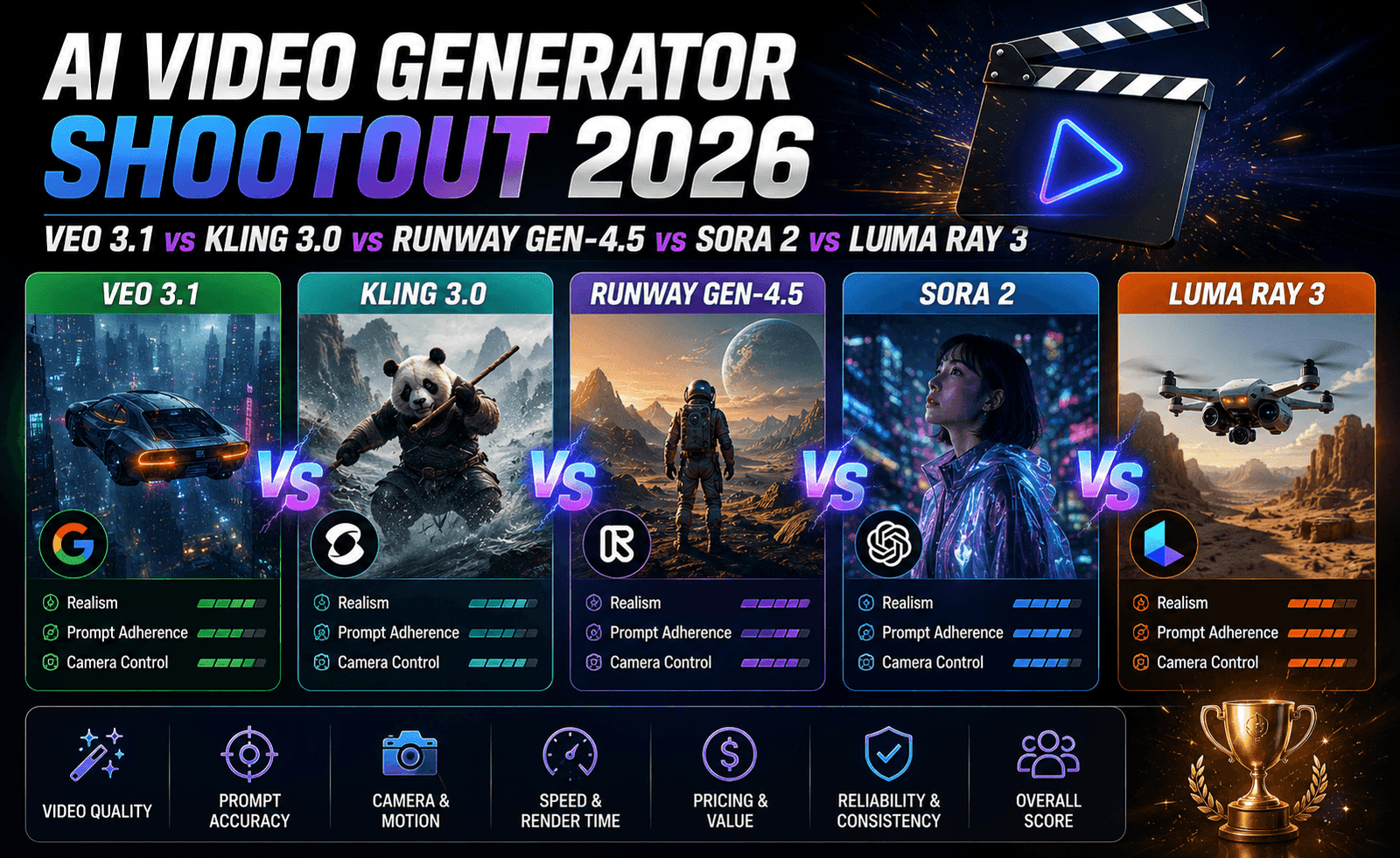
Kling 3.0’s blended API cost lands around $0.10 per second, which makes it the cheapest of the current top-tier models by a real margin, roughly a third cheaper than Veo 3.1’s Fast tier and dramatically cheaper than Sora 2’s per-second rate. For any workflow that needs volume, such as dozens of variations for ad testing, this pricing gap compounds quickly.
Prompt Comprehension
Kling 3.0 handles cinematic language well. Terms like golden hour, shallow depth of field, and handheld verite style produced results that matched the intended mood in most tests. Where it struggled slightly was with very abstract or surreal prompts, where Veo 3.1 and Runway both produced more imaginative interpretations. Kling tends to play it safer and more literal when a prompt gets unusual.
Access and Availability
Kling is accessible globally through its web app and API, though creators building commercial pipelines should check current regional terms of service and content policies, since these have shifted more than once over the last year. We would also note that generations from the free tier carry a visible watermark, which is standard practice across this category but worth planning around if you are testing before committing to a paid plan.
Speed
Render times were competitive with Veo 3.1’s Fast tier and noticeably quicker than Sora 2 in our testing, which matters if you are iterating through many prompt variations in a single session rather than generating one final hero clip.
How Kling 3.0 Handled Our Toughest Test Prompts
We reserve a handful of deliberately difficult prompts for every model we test, specifically designed to expose weaknesses rather than showcase strengths. One recurring test asks for a character to pick up a reflective object, turn it over in their hands, and set it down, a combination of fine motor detail, reflection tracking, and physical weight that trips up most video models. Kling 3.0 handled this sequence more convincingly than any other model in our current rotation, including in the moment the object left the character’s hand, where competing tools often show a visible “snap” or discontinuity. Another stress test involves a crowd scene with at least five moving background characters; Kling’s background figures moved with plausible independent motion rather than the repeating, looping patterns we still see in some competitors.
Where Kling 3.0 lost ground on our harder prompts was in anything requiring stylized or non-photorealistic rendering, such as a specific illustrated or painterly look. Results tended to default toward a more literal, photorealistic interpretation even when the prompt explicitly requested a stylized treatment, which is worth knowing if your use case leans creative rather than commercial.
What Changed Since Earlier Kling Releases
Kling’s earlier releases, including the 2.6 generation we tested last cycle, were already competitive on price but noticeably weaker on two specific fronts: multi-shot continuity and fine physical motion. Kling 3.0 addresses both directly. In our repeat runs of last year’s continuity test prompts, character faces and clothing held together across cuts in a way that simply was not reliable twelve months ago. The physics improvements are even more noticeable in unscripted-feeling motion, hair in wind, water splashing against a surface, fabric settling after a fall, all of which looked noticeably more grounded than the same prompts run against older Kling checkpoints.
Kuaishou has also clearly invested in making the professional and consumer experiences converge. Where earlier Kling releases felt tuned primarily for short-form social content, 3.0’s marketing and default output style lean more toward cinematic framing and pacing, which lines up with what we saw in testing: fewer whip-cut style clips, more deliberate camera movement, and stronger scene composition by default.
Practical Workflow Notes
A few observations from actually working inside the tool rather than just scoring outputs. The web app’s interface is quick to learn, and the daily free-tier allowance is generous enough to genuinely evaluate the model before paying for anything, which is rare in this category. Teams planning to lean on Kling for volume production should budget time for prompt refinement early: because Kling interprets prompts fairly literally, small wording changes produce more predictable, repeatable shifts in output than we saw with Veo 3.1’s more conversational, sometimes unpredictable interpretation. That predictability is actually a feature for high-volume workflows, since it makes prompt templates more reliable across many variations. We would also flag that teams operating in regions with stricter platform requirements should confirm current terms before scaling a campaign, since Kuaishou has adjusted regional policy details more than once over the past year.
Comparison at a Glance
| Criterion | Topeny Score (out of 10) |
|---|---|
| Subject Consistency | 9.4 |
| Physical Motion Realism | 9.2 |
| Cinematic Sequencing | 8.8 |
| Prompt Comprehension | 8.1 |
| Speed | 8.6 |
| Value for Price | 9.5 |
Strengths
- Best-in-class subject and character consistency across multiple shots
- Strongest per-dollar value among current top-tier models
- Physically grounded motion, with fabric, liquid, and stride physics that look more natural than competitors
- Free tier makes initial testing low-risk
- Fast render times suitable for rapid iteration
Weaknesses
- Less imaginative interpretation of abstract or surreal prompts compared to Veo 3.1 and Runway
- Free-tier output carries a visible watermark
- Regional access and content policy terms have changed more frequently than competitors, so teams should check current terms before building a dependent pipeline
- Native audio generation, while present, is not yet as refined as Veo 3.1’s
- Struggles to break from photorealism when a stylized or illustrated look is specifically requested
Best Use Cases
Kling 3.0 is the clear pick for any workflow where volume matters: agencies testing dozens of ad variations, e-commerce teams generating product content at scale, and creators who need to iterate quickly without watching costs climb. It is also a strong choice for narrative shorts where character consistency across a scene matters more than experimental visual style.
Frequently Asked Questions
Is Kling 3.0 free to use?
There is a free tier with daily generation limits and a visible watermark on output. Paid plans and API access remove the watermark and raise the usage ceiling.
How does Kling 3.0 compare to earlier Kling versions?
The 3.0 release brought a clear step up in multi-shot continuity and physical motion realism, which were the most noticeable weaknesses in earlier Kling versions during our previous testing rounds.
Is Kling 3.0 good for dialogue scenes?
It handles dialogue adequately but is not the strongest option in this category for lip-sync accuracy; Veo 3.1 remains ahead here.
Can I use Kling 3.0 output commercially?
Commercial usage rights depend on your specific plan tier; teams should verify current licensing terms directly with Kuaishou before using generated video in paid campaigns.
Verdict
Kling 3.0 earns its reputation as the value leader of 2026. It is not the most imaginative model in the category and its audio still trails Google’s, but for subject consistency, physical realism, and sheer cost-efficiency, it is hard to argue with the numbers. Any team running high-volume video testing should have Kling 3.0 in the rotation.
Topeny Overall Score: 8.9 / 10





Leave a Reply