

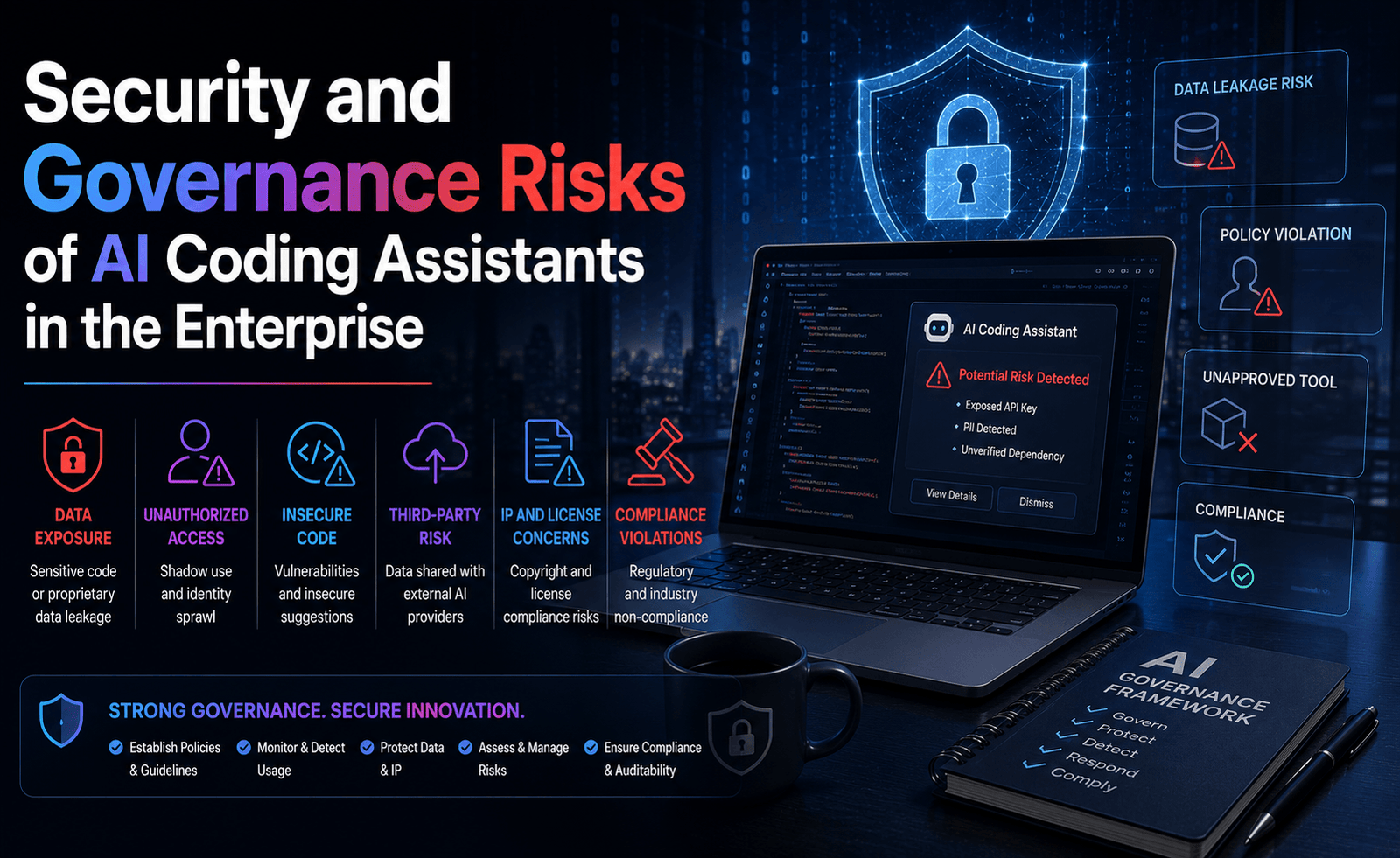
Almost every enterprise engineering organization now uses AI coding assistants in some form, and almost every one of those organizations confirms that AI-generated code has already made its way into production repositories. What is far less consistent is whether a formal policy governs how that happens. That gap, widespread adoption paired with immature governance, is the defining security story of AI coding assistants in 2026, and it is the subject of this report.
Why This Risk Category Is Different
Traditional application security tooling was built around a mostly stable assumption: code enters a repository at a fairly predictable pace, written by identifiable engineers who can be asked about their reasoning. AI coding assistants break that assumption in two ways at once. First, they can dramatically increase the rate at which code is produced, which strains review processes that were sized for a slower pace of change. Second, once AI-generated code is committed, most organizations have no reliable way to distinguish it from human-written code, which means security teams cannot easily apply targeted scrutiny to the code most likely to carry AI-specific risk patterns. Without that visibility, governance becomes reactive rather than preventive.
Where the Risk Actually Lives
Code That Looks Clean but Isn’t
AI-generated code tends to be syntactically tidy: consistent formatting, no typos, no obviously broken structure. That surface-level cleanliness creates a false sense that the logic underneath is equally sound. It often is not. Subtle problems, an access control check that is missing rather than wrong, an input validation step that was quietly skipped, a default configuration that favors convenience over security, do not announce themselves the way a syntax error does, and they are exactly the kind of issue a rushed review is most likely to miss.
Secrets and Sensitive Data in Prompts
A recurring pattern across multiple independent studies this year is developers unintentionally exposing sensitive information, API keys, credentials, internal schema details, proprietary logic, by pasting it into a prompt or leaving it in code that gets sent as context to a cloud-hosted model. Public repositories that show signs of AI-assisted development have also been found to carry a higher rate of accidentally committed secrets than repositories without that signature, and a striking share of exposed credentials remain valid and unrotated well after the fact. None of this requires a malicious actor; it happens through ordinary, well-intentioned use of the tools.
Supply Chain and Dependency Risk
AI assistants can suggest a package that does not exist, sounds plausible, and could in principle be registered by an attacker specifically to catch developers who copy the suggestion without checking, a pattern security researchers have started referring to as dependency confusion through AI hallucination. More broadly, assistants do not inherently vet the trustworthiness or maintenance status of a package before suggesting it, which places the verification burden squarely back on the developer.
Volume Outpacing Review Capacity
Perhaps the most structural risk is simply throughput. When a single developer can generate what used to take a team a day in a fraction of the time, the review process downstream does not automatically scale to match. Several recent industry studies have found that AI-assisted development correlates with a meaningfully higher rate of security findings per commit compared to traditional development, not because the underlying model is careless, but because the sheer volume of change makes thorough review harder to sustain.
Agentic Tool Access
As assistants move from suggesting text to actually executing commands, reading files, and calling external services, they start to resemble a new kind of non-human identity operating inside the development environment. That means the same discipline applied to service accounts and automation credentials, least-privilege access, credential rotation, audit logging of what the agent actually did, needs to be applied to agentic coding tools too, and many organizations have not yet extended their identity governance programs to cover this case.
The Compounding Effect: When One Vulnerability Spreads
Insecure AI-generated code rarely stays contained to the file it was written in. Modern codebases are highly interconnected, and a flawed pattern introduced by an assistant in one module, an insufficient input check, a permissive default, is easily copied by the same assistant into similar code elsewhere in the same session, or reused by a different developer who asks for something similar later. Because AI assistants are often trained on broad patterns rather than a single organization’s specific security requirements, a mistake in one place can propagate across microservices before anyone notices, creating an attack surface that grows faster than a traditional, human-paced development process would typically allow. Security researchers tracking publicly disclosed vulnerabilities linked to AI-generated code have observed this propagation pattern repeatedly across open-source projects over the past year, and there is little reason to expect private enterprise codebases are structurally immune to the same dynamic.
Regulatory and Contractual Exposure
Beyond the direct security risk, AI-assisted development is starting to intersect with regulatory and contractual obligations in ways many organizations have not fully mapped out. Industries subject to data residency requirements need to know precisely where a prompt containing proprietary or customer-related code actually goes, not just where the primary product is hosted. Organizations bound by client contracts that restrict how source code may be shared with third parties may find that pasting code into certain cloud-hosted assistants technically violates those terms, even when no human ever reviews the specific prompt. And companies operating under frameworks that require demonstrable audit trails for how software changes are made may struggle to produce that trail for changes an autonomous agent made without a corresponding human-readable record of its reasoning.
None of these issues are unsolvable, but they require deliberate attention rather than an assumption that a vendor’s general security certifications automatically cover them. Legal and compliance teams increasingly need a seat at the table when AI coding tools are evaluated, not as a formality but because the exposure is genuinely different from a typical software purchase.
Building an Incident Response Plan for AI-Assisted Code
Most organizations have a reasonably mature incident response process for a traditional security breach. Far fewer have thought through what happens specifically when a serious vulnerability is traced back to AI-generated code already running in production. A few questions worth answering in advance rather than in the middle of an incident: Can your team quickly identify which other parts of the codebase might share the same flawed pattern, given that AI assistants tend to repeat approaches across similar tasks? Is there a record of which tool and which session produced the affected code, in case the vendor needs to be looped in? And does your post-incident review process explicitly consider whether the root cause was a gap in AI-specific review practices, so the fix addresses the process and not just the individual bug?
Why Governance Has Lagged
A large share of security leaders report active concern about AI-generated code risk, yet a comparable share of organizations still rely primarily on manual review to catch problems in that code, and a substantial portion have no formal policy at all governing how the tools should be used. This is not because security teams are unaware of the risk; it is because the tooling and processes needed to govern AI-assisted development at scale, tracking which code was AI-generated, applying differentiated review policies, monitoring what leaves the environment through a prompt, are still catching up to how quickly adoption spread.
A Practical Governance Checklist
Based on our conversations with security and engineering leaders who feel furthest ahead on this problem, a few practices show up consistently:
- Treat AI coding tools as part of your software supply chain, not as a personal productivity app, which means they belong in the same vendor risk review process as any other tool that touches proprietary code.
- Establish a written policy covering which tools are approved, what kinds of data may never be pasted into a prompt, and what review is required before AI-assisted code can merge.
- Understand each vendor’s data handling model in detail: whether prompts and code are used for model training, how long data is retained, and whether a self-hosted or zero-retention option exists for sensitive codebases.
- Automate what manual review cannot keep up with: static analysis, secret scanning, and dependency verification on every commit, with particular attention to commits flagged as AI-assisted.
- Extend identity and access governance to agentic tools, applying least-privilege principles and audit logging to what an autonomous coding agent is allowed to execute.
- Avoid rewarding raw output volume in performance metrics, since it creates a quiet incentive to accept AI suggestions without the scrutiny they need.
What Good Vendor Answers Sound Like
When we evaluate AI coding assistants for our own test reports, we ask every vendor the same handful of questions, and the quality of the answer is often as informative as the product itself: Is customer code ever used to train models, and can that be contractually excluded? What is the data retention period for prompts and generated code? Is there a self-hosted or virtual-private-cloud deployment option? What audit logging exists for actions an agent takes autonomously, such as running a command or calling an API? Vendors that answer these questions specifically and in writing are, in our experience, also the ones that tend to take the underlying security posture of their product seriously.
The Bottom Line
None of this is an argument against using AI coding assistants; the productivity case for them is real and well established at this point, as we cover elsewhere in this series. It is an argument against adopting them the way many organizations did in the last two years: quickly, informally, and without governance keeping pace. The risk is manageable, but only if it is treated as seriously as any other significant change to how proprietary code and sensitive data move through your development pipeline.



Leave a Reply