
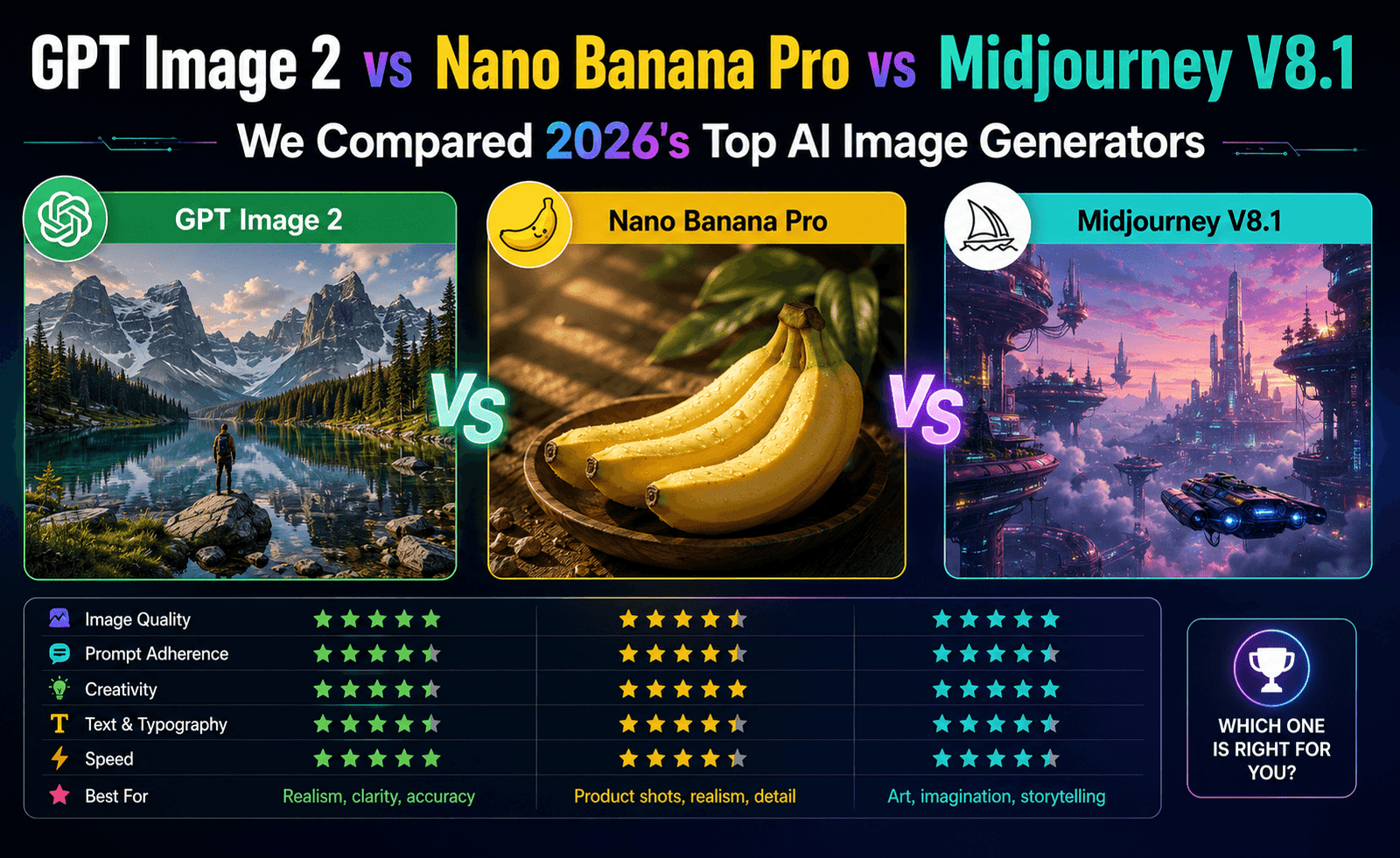
Twelve months ago, choosing an AI image generator was a two-horse race: Midjourney for artists, and a scattering of Stable Diffusion forks for everyone who wanted to self-host. That era is over. In 2026, the field has split into at least half a dozen serious contenders, each with a genuinely different strength, and the “best” tool now depends heavily on what you’re trying to make. At Topeny, we spend most of our working hours generating, comparing, and stress-testing AI software, so we put together this report to answer the question our readers ask us most: which image generator should you actually pay for right now?
This report focuses on three models that come up constantly in our testing queue and in industry leaderboards: OpenAI’s GPT Image 2, Google’s Nano Banana Pro (the consumer-facing name for the Gemini 3 Pro Image model), and Midjourney V8.1. We also touch on where Black Forest Labs’ FLUX.2 and Stable Diffusion 3.5 fit into the picture, since no comparison is complete without the open-weight side of the market.
How We Evaluated These Tools
Rather than inventing our own numeric scoring system and presenting it as gospel, we built our evaluation around four practical dimensions that matter to real users: output quality (photorealism, composition, prompt adherence), editing and iteration (can you refine an image without starting over), speed and reliability, and total cost of ownership. Where independent blind-vote benchmarks exist — such as the Artificial Analysis Image Arena, which ranks models using a conservative TrueSkill score derived from tens of thousands of head-to-head human votes — we reference those rather than guessing, because self-reported “we tested it and it’s the best” claims from any vendor (including model providers themselves) should always be taken with a grain of salt.
GPT Image 2: The Current Leaderboard Leader
As of mid-2026, GPT Image 2 sits at the top of most independent blind-vote leaderboards, including the Artificial Analysis Image Arena, where it holds a meaningfully larger lead over the second-place model than any previous generation of image models has managed. It’s a closed-source, API-and-app-only model, which means you can’t self-host it, but you gain a very tight integration with ChatGPT’s conversational interface. In practice, this is where GPT Image 2 separates itself from pure text-to-image tools: you can ask for an image, then say “make the lighting warmer, move the cup to the left, and lose the steam,” and the model reliably applies just those changes without redrawing the whole scene. For workflows that involve a lot of back-and-forth — client revisions, iterative concept work, ad variations — that conversational editing loop is a real productivity difference, not a gimmick.
The trade-off is that GPT Image 2 is a general-purpose model bolted onto a general-purpose chat product. It doesn’t offer the deep style controls, seed management, or community remix culture that Midjourney users are used to, and pricing is usage-based through the API or bundled into ChatGPT’s subscription tiers rather than sold as a dedicated image-generation plan.
Nano Banana Pro: The Knowledge-Grounded Generalist
Nano Banana Pro is Google DeepMind’s Gemini 3 Pro Image model, and it earned its nickname from the developer community before Google leaned into the branding itself. Its standout feature is that it ships full 4096×4096 output as a standard tier — a genuinely higher default resolution than most competitors offer without an upscaling pass — and it leans on Gemini’s broader world knowledge to produce accurate diagrams, infographics, and “grounded” edits that reference real facts rather than generic AI guesses. That makes it unusually strong for anything that mixes text, data, and imagery: think product infographics, explainer graphics, or annotated diagrams, categories where most pure diffusion models tend to hallucinate labels or garble numbers.
A lighter, faster sibling called Nano Banana 2 (Gemini 3.1 Flash Image) trades some of the Pro model’s polish for roughly double the generation speed, and it’s accessible for free inside the standard Gemini app, which makes it one of the easiest ways for a newcomer to get a feel for high-quality AI image generation without committing to a subscription.
Midjourney V8.1: Still the Artistic Benchmark
Midjourney has never chased leaderboard Elo scores the way its newer competitors do, and that’s arguably the point — it optimizes for a distinctive, painterly, “Midjourney look” that a large community of artists and designers still prefer over the more photographic, literal output of GPT Image 2 or Nano Banana Pro. V8.1, which became the default model in June 2026, brought faster standard-speed generations, better small-detail retention, HD 2K output, and a “Raw mode” for users who want less of Midjourney’s signature stylization and more literal prompt following.
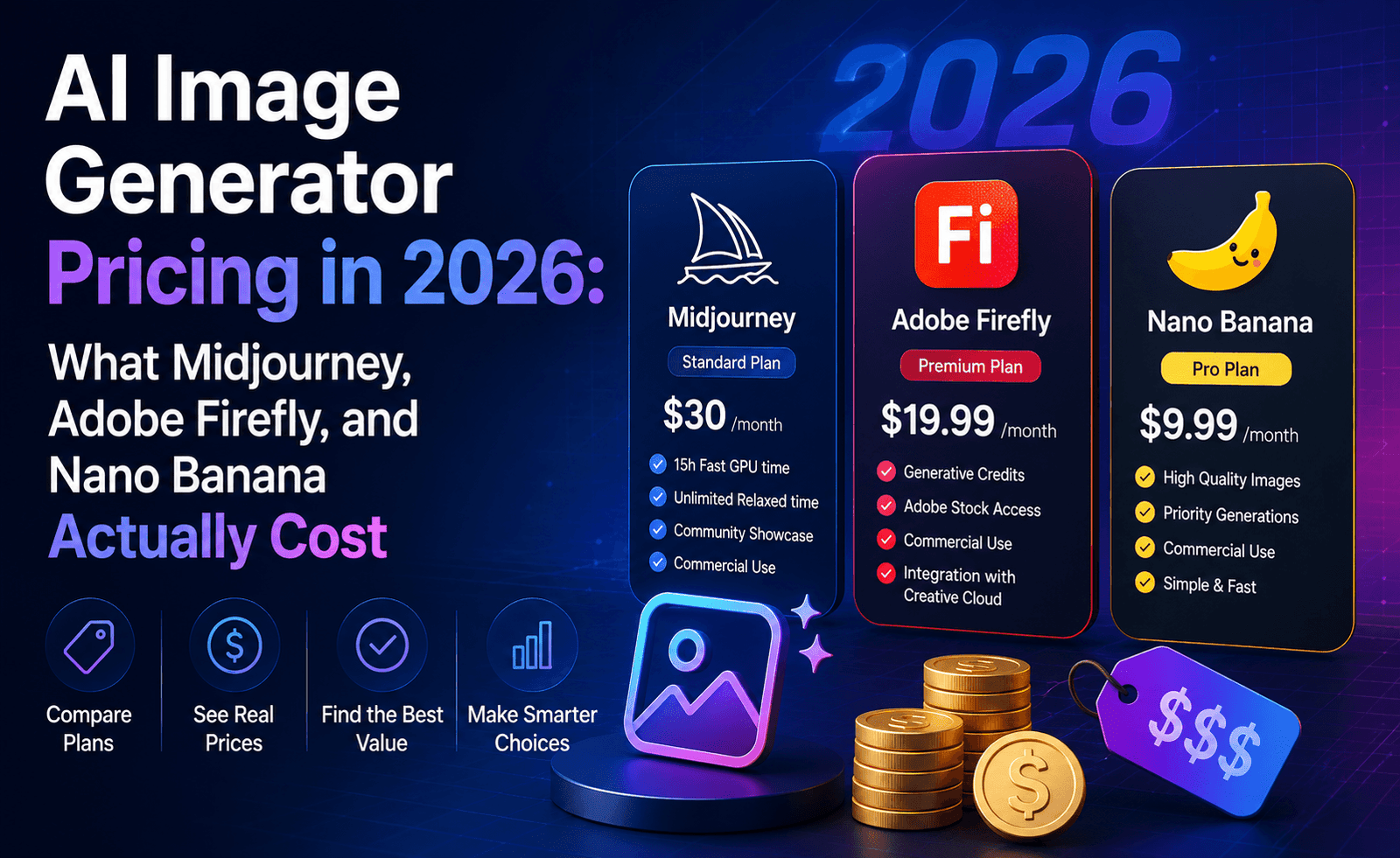
Midjourney’s pricing structure is unusual and worth understanding before you subscribe: instead of buying a number of images, you buy monthly blocks of “fast GPU time.” The four plans are Basic ($10/month), Standard ($30/month), Pro ($60/month), and Mega ($120/month), with roughly 20% savings if you commit to annual billing. Once you burn through your fast hours, Standard-tier-and-above subscribers drop into “Relax mode,” which is unlimited but queued, with wait times that can run anywhere from instant to thirty minutes depending on server load. There is no free trial — Midjourney removed it back in 2023 — and companies with more than $1 million in annual gross revenue are contractually required to be on the Pro or Mega tier to use outputs commercially, which is a detail that trips up a surprising number of small businesses that scale past that threshold.
Side-by-Side Comparison
| Model | Best For | Access | Standout Feature | Notable Limitation |
|---|---|---|---|---|
| GPT Image 2 | Iterative, conversational editing | ChatGPT / OpenAI API | Reliable natural-language edits without full redraws | No dedicated standalone image-plan pricing |
| Nano Banana Pro | Infographics, diagrams, knowledge-grounded images | Gemini app / Google AI Studio / API | Native 4096×4096 output, world-knowledge accuracy | Less “artistic” than Midjourney by design |
| Midjourney V8.1 | Stylized, painterly, cinematic visuals | midjourney.com (Discord or Google login) | Distinctive aesthetic, mature prompt vocabulary | No free trial; GPU-time pricing is easy to misjudge |
| FLUX.2 (Black Forest Labs) | Production workflows, character consistency | Open-weight + hosted API tiers | Dev/Pro/Max tiers for different budgets, self-hostable | Requires more technical setup for local use |
Which One Should You Actually Use?
If your work involves rapid iteration with a client watching over your shoulder — agency creative, product mockups, ad concepting — GPT Image 2’s conversational editing will likely save you the most time. If you’re producing content that mixes real information with visuals, like data-driven marketing graphics, onboarding diagrams, or educational material, Nano Banana Pro’s grounding in factual knowledge is a genuine differentiator that pure aesthetic models can’t match. And if the final image itself needs to look distinctive, cinematic, or painterly — book covers, concept art, brand mood boards — Midjourney’s aesthetic remains, in our view, unmatched, even if its pricing model takes some getting used to.
For teams that want to avoid picking a single horse, it’s increasingly common to run the same prompt across two or three of these models before committing to a direction, since a five-minute comparison test costs very little relative to the hours saved by choosing the right tool up front.
A Note on Volatility
We want to be upfront about something that’s easy to gloss over in “best of” content: this market moves on a roughly monthly release cycle right now. Leaderboard positions, pricing tiers, and even default model versions shift often enough that any comparison — including this one — should be treated as a snapshot rather than a permanent verdict. We periodically revisit our test reports as new versions ship, and we’d encourage you to check each provider’s official pricing page before subscribing, since promotional pricing and credit allocations are the details most likely to change between when we publish and when you read this.
Frequently Asked Questions
Is GPT Image 2 better than Midjourney?
“Better” depends on the metric. On blind-vote leaderboards that measure prompt accuracy and general image quality, GPT Image 2 currently ranks higher. But Midjourney is optimized for a distinctive visual style rather than literal accuracy, so for creative and artistic work, many designers still prefer its output even when it scores lower on generalized benchmarks. Treat leaderboard rank as one input, not the final word.
Can I use these models for commercial projects?
Generally yes, but the terms differ meaningfully by provider. Midjourney requires businesses above a $1 million annual revenue threshold to be on its Pro or Mega plan for commercial use. Adobe Firefly markets itself specifically around commercial safety because it trains only on licensed and public domain content. Always read the current terms of service for the specific plan you’re on, since commercial licensing details are exactly the kind of thing that changes between model versions.
Do I need a paid plan to test these tools?
Not necessarily. Nano Banana 2 is accessible for free inside the standard Gemini app, and GPT Image 2’s capabilities are partially reachable through ChatGPT’s free and Plus tiers depending on current usage limits. Midjourney is the outlier here — it has no free trial, so budget at least $10 for a Basic month if you want to test it firsthand.
Which model handles text and typography inside images best?
None of the three models covered in this report is the strongest choice for typography-heavy work like logos and posters — that’s a category where Ideogram 3.0 currently leads. We cover text-rendering specifically in a separate test report linked from our AI Image Generation section.
The Bottom Line
There is no single “best” AI image generator in 2026 — there’s a best tool for your specific job. GPT Image 2 wins on iterative editing and leaderboard consistency, Nano Banana Pro wins on resolution and factual grounding, and Midjourney still wins on pure aesthetic distinctiveness. Rather than picking one and hoping for the best, we’d recommend testing your actual, real-world prompts — not generic demo prompts — across at least two of these before committing budget to a monthly subscription. As always, treat pricing and rankings in this report as a mid-2026 snapshot, and confirm current details on each provider’s official site before you buy.


Leave a Reply