
Introduction
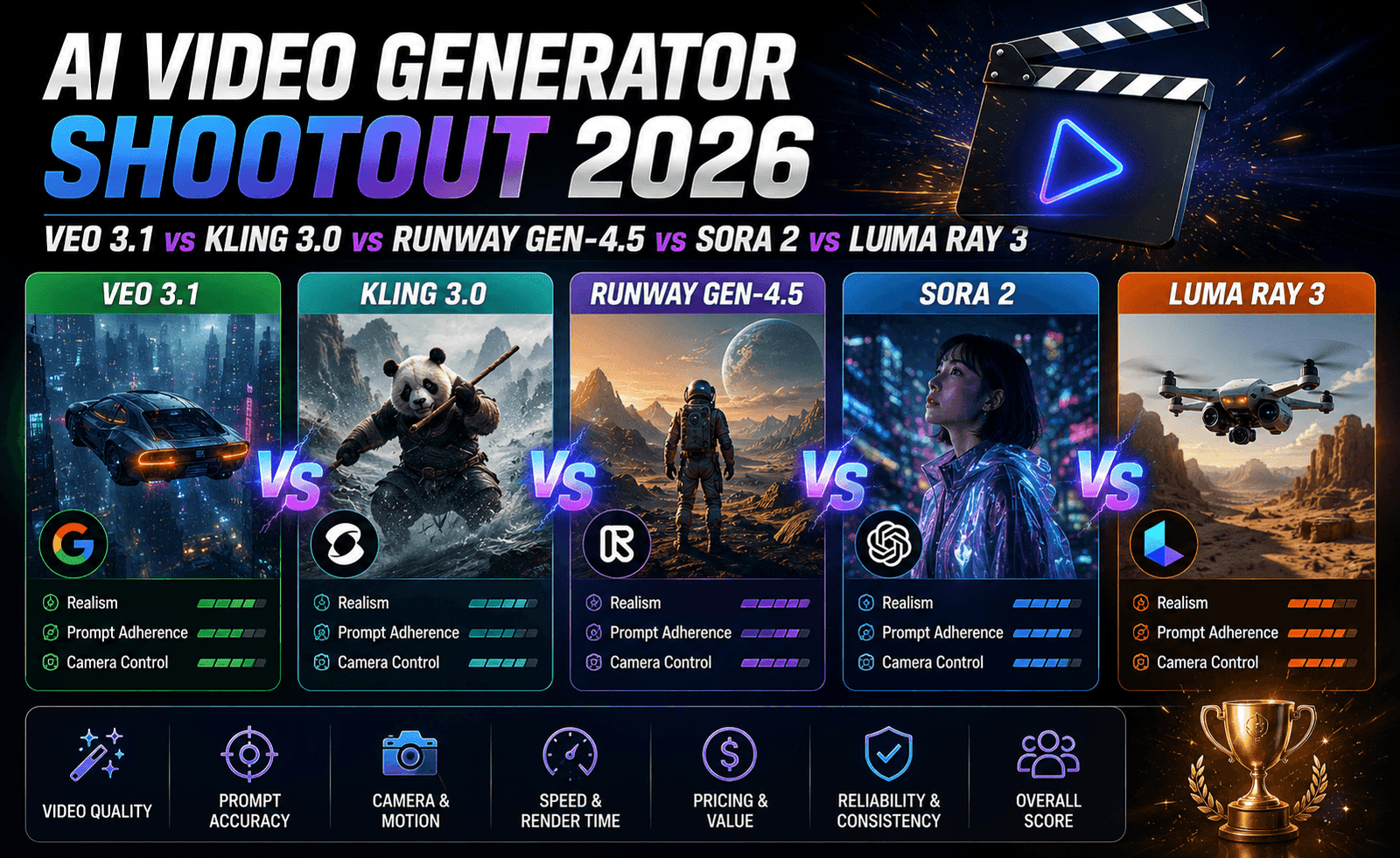
Individual test reports are useful, but the question the Topeny Team gets asked most often is simpler: if you could only pick one AI video generator today, which one would it be? To answer that properly, we ran the five models that matter most for working creative and marketing teams, Google Veo 3.1, Kling 3.0, Runway Gen-4.5, OpenAI Sora 2, and Luma Dream Machine (Ray 3), through the exact same test bank, back to back, and scored them against identical criteria. This report is the head-to-head summary of that process.
Testing Methodology
Every model was run through the Topeny Team’s standard 40-prompt suite: photorealistic human subjects, nature and environmental scenes, product shots, complex camera movement, dialogue and audio-dependent scenes, and multi-shot continuity. Each prompt was generated three times per model to check consistency, and every output was scored independently by two reviewers before results were averaged. Where a model offered multiple quality tiers, Fast versus Standard, for example, we tested both and reported the tier most comparable to the others in price.
The Contenders
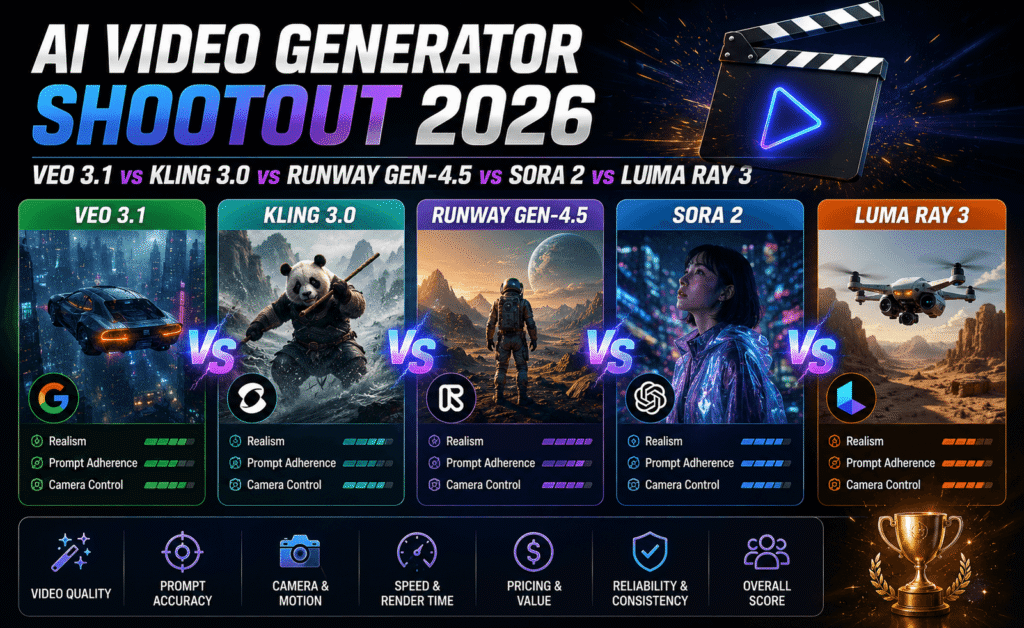
A quick note on positioning before the results: these five tools are not all trying to win the same competition. Veo 3.1 and Kling 3.0 are primarily model-quality plays. Runway Gen-4.5 is a creative workspace built around editing control. Sora 2 is a capable but sunsetting model, with its API scheduled for discontinuation on September 24, 2026. Luma’s Ray 3 is the strongest option for cinematic camera movement generated directly from a single keyframe image, though it should be noted our current dataset score for Luma still partly reflects the earlier Ray 2 release and is due for a full retest as Ray 3 usage data matures.
Category-by-Category Results
Realism and Video Quality
Veo 3.1 and Kling 3.0 led this category, essentially tied, Veo edging ahead on lighting and skin tones, Kling edging ahead on physical motion and fabric physics. Sora 2 was close behind on pure cinematic quality. Runway’s own model trailed slightly here, though its integration of Veo inside the platform closes that gap for anyone using the hybrid workflow. Luma’s Ray 3 produced strong results specifically on camera movement from a static keyframe but was less consistent on fully generated scenes without a reference image.
Prompt Adherence
Sora 2 and Veo 3.1 handled complex, multi-clause prompts most reliably. Kling 3.0 performed well on cinematic language but was more literal and less imaginative on abstract or surreal requests. Runway’s strength here is not really prompt adherence in isolation, it is the ability to correct a shot iteratively using Keyframes and Motion Brush rather than needing a perfect prompt on the first attempt.
Native Audio
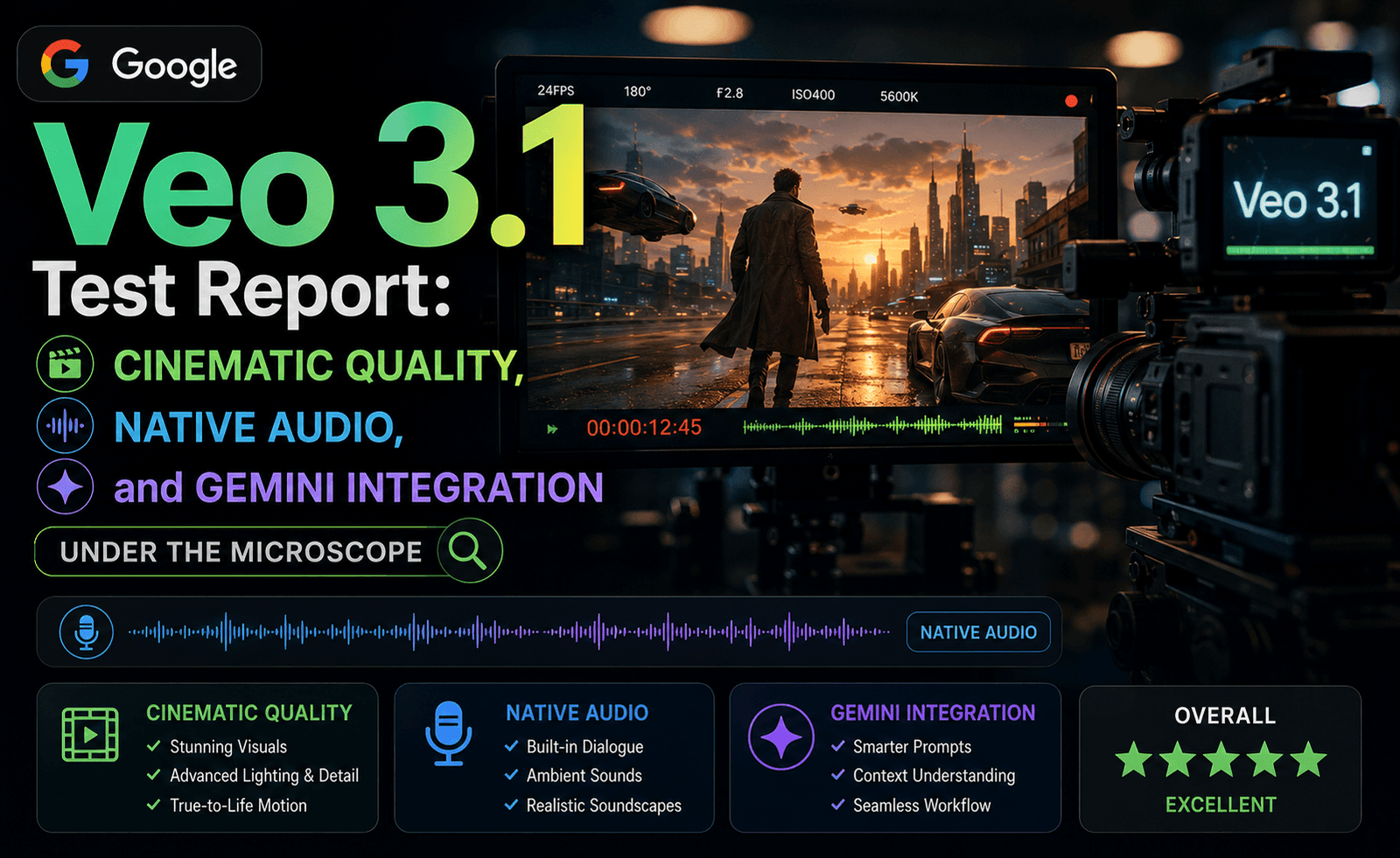
Veo 3.1 was the clear leader, with Sora 2 close behind. Kling’s audio has improved but still trails both. Runway’s own native audio is limited, though using Veo inside the Runway workspace effectively imports Google’s audio quality. Luma does not currently prioritize native audio generation in the same way.
Camera Control
No contest: Runway Gen-4.5 wins this category outright with its explicit focal length, pan, dolly, and rack focus parameters. Luma’s Ray 3 is the strongest of the remaining models specifically for smooth cinematic movement generated from a keyframe. Veo 3.1, Kling 3.0, and Sora 2 all rely on descriptive rather than parametric camera language.
Speed
Kling 3.0 and Veo 3.1’s Fast tier were the quickest to render in our testing, both comfortably ahead of Sora 2, which was the slowest model tested. Runway’s render times varied depending on which underlying model and editing tools were engaged for a given shot.
Pricing
Kling 3.0 remains the cheapest at roughly $0.10 per second blended. Veo 3.1’s Fast tier sits around $0.15 per second. Runway uses a credit-based subscription instead of per-second pricing, with plans ranging from roughly $12 to $15 per month for occasional use up to $76 to $95 per month for heavy usage. Sora 2 Pro, at roughly $0.75 per second, remains by far the most expensive model in this comparison.
Access and Availability
Veo 3.1, Kling 3.0, and Runway Gen-4.5 are all actively developed and broadly available. Sora 2 is accessible only through its API, which OpenAI has confirmed will shut down on September 24, 2026, after already discontinuing the consumer web and app experiences in April 2026. Teams should factor this directly into any long-term platform decision.
A Closer Look: The Same Prompt, Five Models
To make the comparison concrete rather than purely score-based, we ran one representative prompt, a mid-shot of a person walking through a rain-soaked city street at night, coat collar up, neon signage reflecting in puddles, camera slowly tracking alongside, through all five models using identical wording. Kling 3.0 produced the most physically convincing puddle reflections and coat movement. Veo 3.1 produced the most convincing ambient sound, layering rain, distant traffic, and footsteps believably in sync with the visual. Runway’s own model handled the base generation adequately, but the version we built afterward using Motion Brush to isolate the coat’s movement from the background looked noticeably more polished than any single-pass generation from another tool. Sora 2 handled the lighting and reflections beautifully but rendered the walking motion slightly too smooth, missing some of the subtle weight-shift Kling captured. Luma’s Ray 3, run from a generated keyframe of the same scene, produced the smoothest camera tracking motion of any model in the test, which is exactly the specific strength its architecture is built around.
No single model won every dimension of this one prompt, which is really the core finding of this entire shootout: the “best” tool depends heavily on which specific quality your project weights most heavily.
Where Each Model Is Headed Next
None of these five products are standing still, which is worth keeping in mind before treating any single ranking as permanent. Google has been shipping Veo point releases at a fast clip, and each one has closed a specific gap noted in our previous report, most recently around prompt comprehension and audio timing. Kuaishou’s Kling team has followed a similar pattern, with each major version targeting the weakest area flagged in the prior cycle’s testing, which is exactly how 3.0 ended up fixing continuity and physical motion. Runway’s roadmap has leaned into deeper multi-model integration rather than purely chasing base-model quality, a bet that the editing workspace, not the underlying model, is where it can defend a durable advantage. Luma’s Ray 3 is the newest release in this comparison, and our current score should be read as provisional until we complete a dedicated full-suite retest once broader usage patterns settle. Sora’s trajectory is the clearest of all five: OpenAI has confirmed the API shutdown date, so barring a reversal, this is very likely the final Topeny Team report to feature Sora 2 as an active recommendation rather than a historical reference point.
Overall Rankings
| Rank | Model | Topeny Overall Score | Best For |
|---|---|---|---|
| 1 | Kling 3.0 | 8.9 / 10 | Value, consistency, high-volume workflows |
| 2 | Runway Gen-4.5 | 8.8 / 10 | Professional control and editing |
| 3 | Google Veo 3.1 | 8.7 / 10 | Audio quality, ease of use, Google ecosystem |
| 4 | Luma Dream Machine (Ray 3) | 7.6 / 10 | Cinematic camera movement from a single keyframe |
| 5 | Sora 2 | 7.4 / 10 | Long-form narrative consistency (short remaining runway) |
Recommendations by Use Case
If You’re a Filmmaker or Motion Designer
Runway Gen-4.5, for the camera control and editing tools alone. The ability to use Veo 3 and 3.1 inside the same workspace makes it even more compelling.
If You’re Running Paid Social or UGC-Style Ad Testing
Kling 3.0, for the combination of consistency and per-second cost when you need dozens of variations quickly.
If You’re a Marketer Who Wants the Easiest Path to Quality
Google Veo 3.1, especially if your team already has Gemini Advanced access and wants conversational, iterative prompting without a steep learning curve.
If You’re Building a Long-Form Narrative Project
Sora 2 still has the edge on multi-shot narrative consistency, but given the confirmed API shutdown date, the Topeny Team would recommend testing Kling 3.0 and Veo 3.1 for the same use case before committing.
If You Want Cinematic Camera Movement From a Still Image
Luma’s Ray 3 remains the most natural fit for this specific workflow, though we would recommend a fresh look as more Ray 3 usage data becomes available.
Frequently Asked Questions
Is there a single best AI video generator in 2026?
Not really. The top three models in this comparison, Kling 3.0, Runway Gen-4.5, and Veo 3.1, are close enough that the right choice depends more on your workflow than on a single quality score.
Should I avoid Sora 2 entirely?
Not necessarily, if you are finishing an existing project before its September 24, 2026 API shutdown. For new projects, the Topeny Team would look elsewhere first.
Can I use more than one of these tools in the same production?
Yes, and many teams already do. Using Runway as the editing environment, with Veo or Kling as the underlying generation model, is an increasingly common combination.
How often does the Topeny Team update this comparison?
This category moves quickly. We retest whenever a major model release ships, and we recommend checking back before making a long-term platform commitment.
Verdict
If the Topeny Team had to pick one tool for a general-purpose team in 2026, it would be a close call between Kling 3.0 and Runway Gen-4.5, decided mostly by whether raw cost-efficiency or editing control matters more to your specific workflow. Veo 3.1 remains a very close third and the easiest tool to recommend to a non-technical team. Sora 2 stays relevant mainly as a capability benchmark rather than a forward-looking recommendation, and Luma’s Ray 3 is worth a dedicated look if camera movement from a keyframe is your primary use case.





Leave a Reply